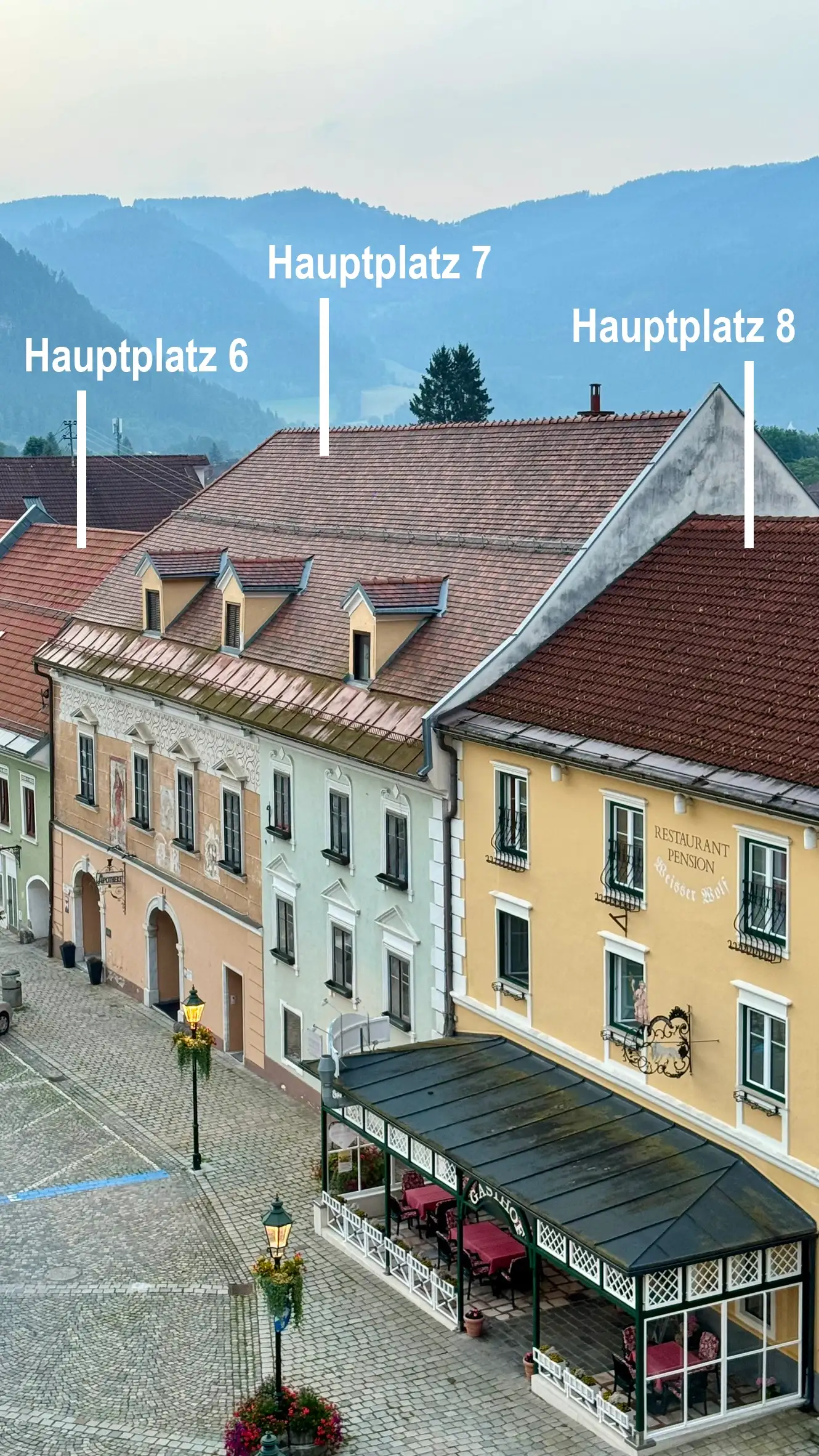
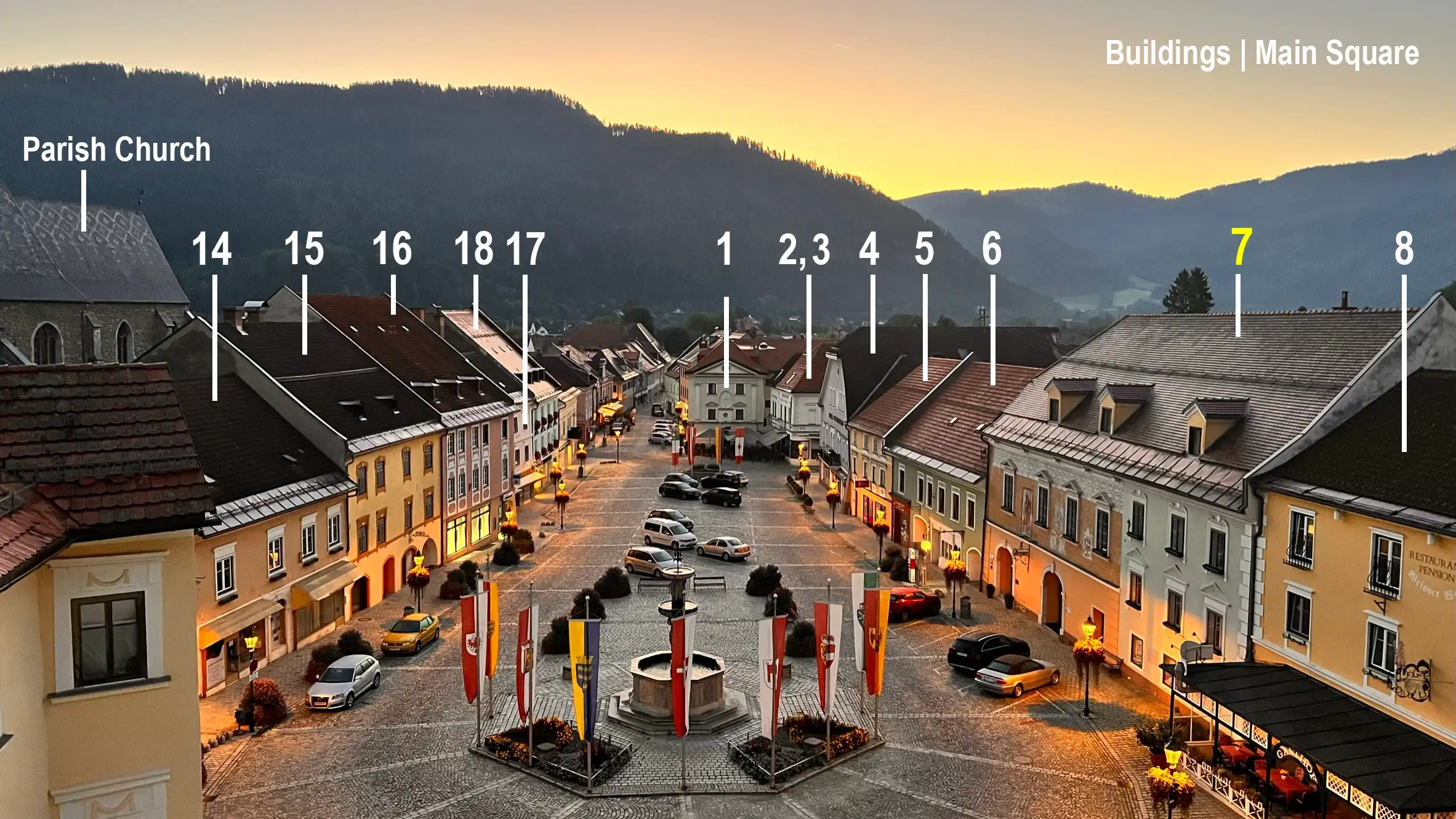
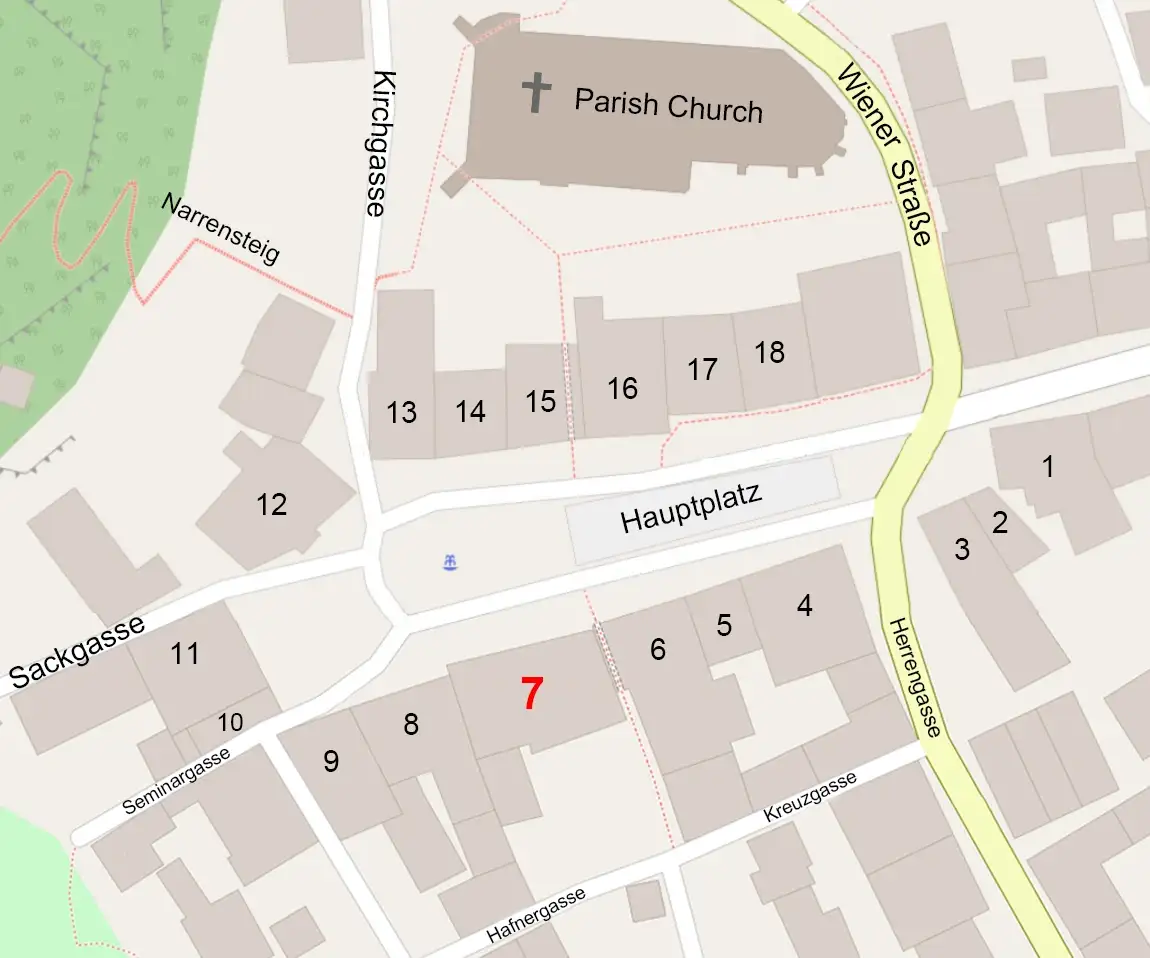
Hauptplatz 7 | Pharmacy
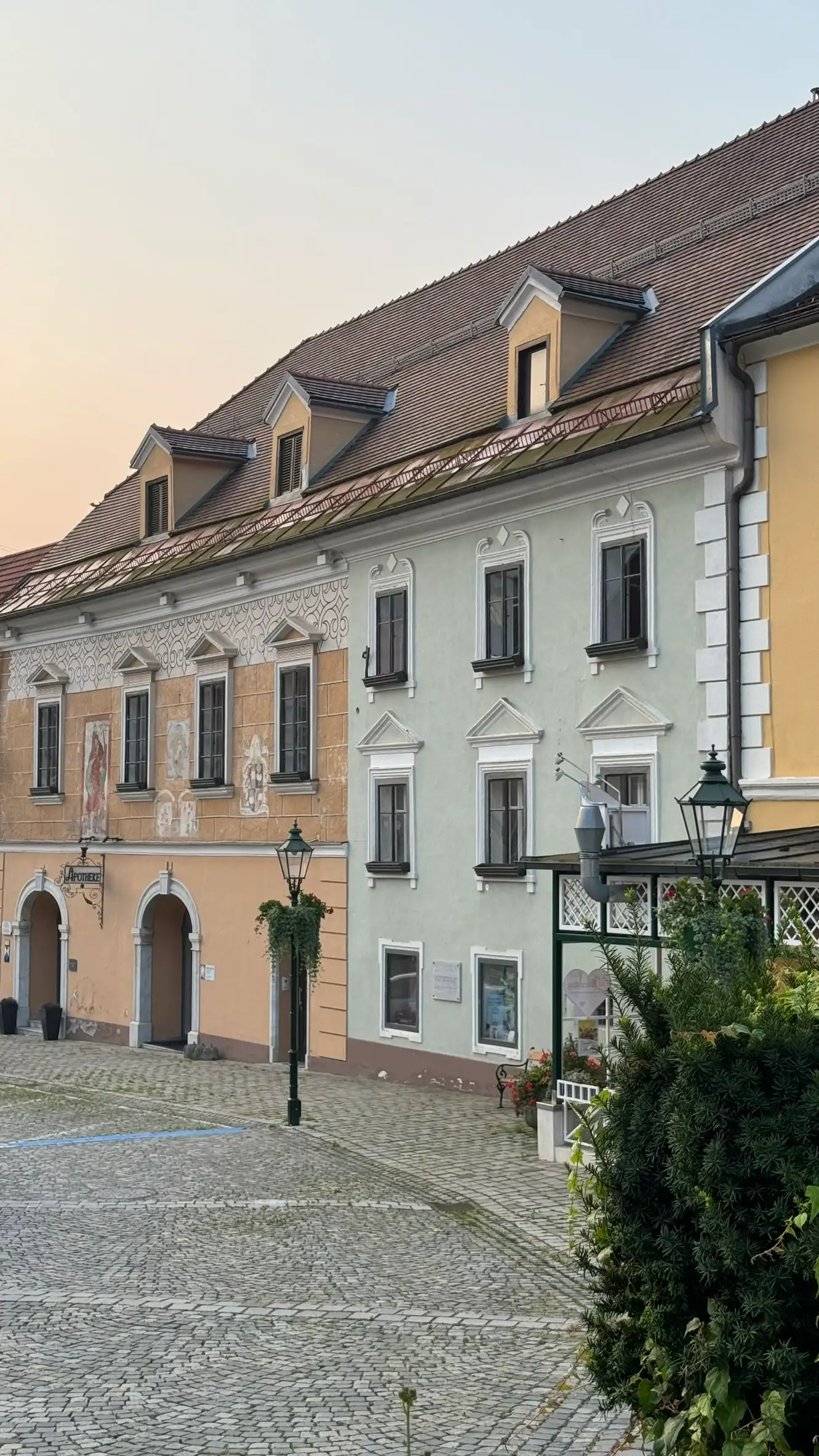
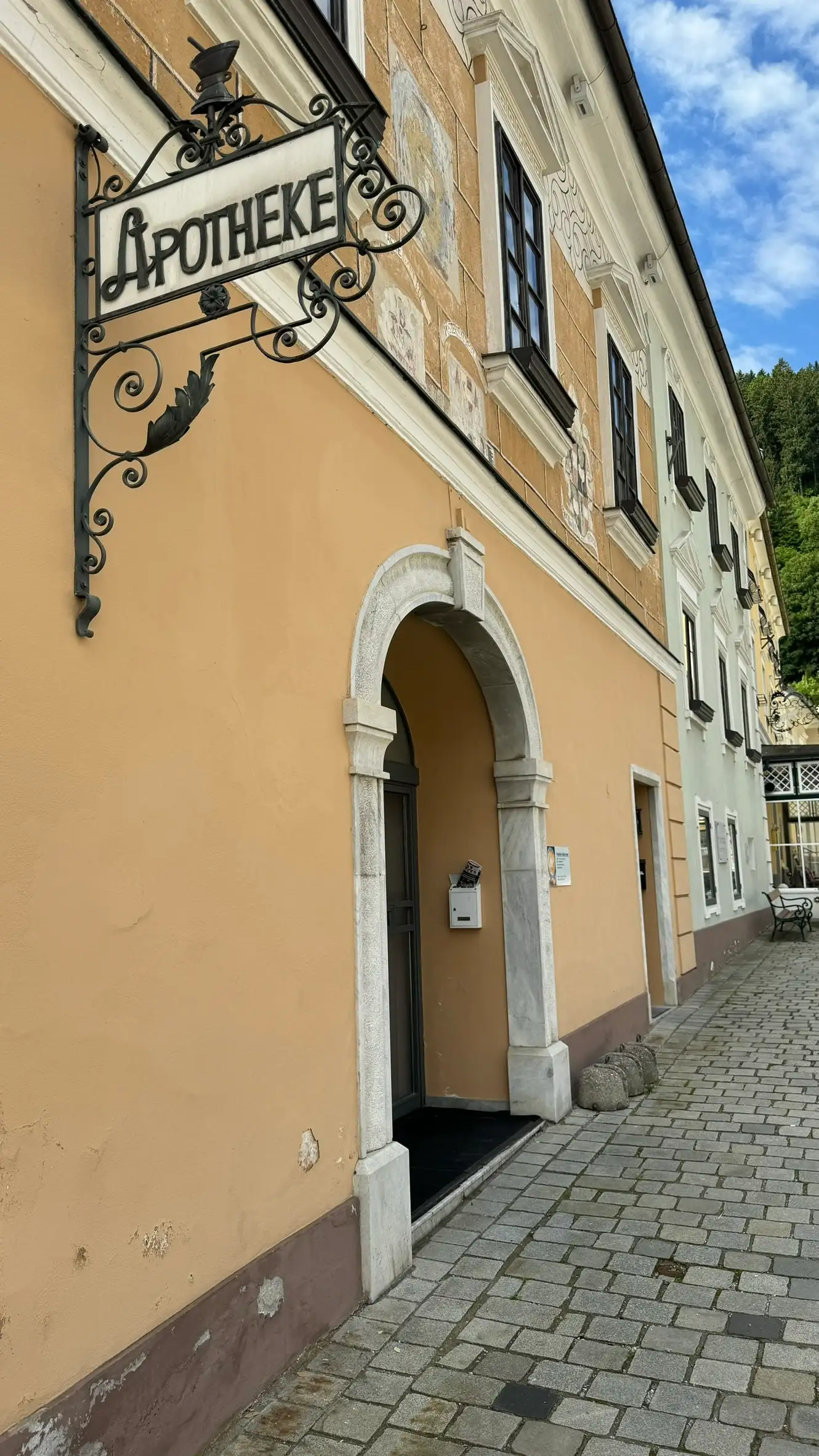
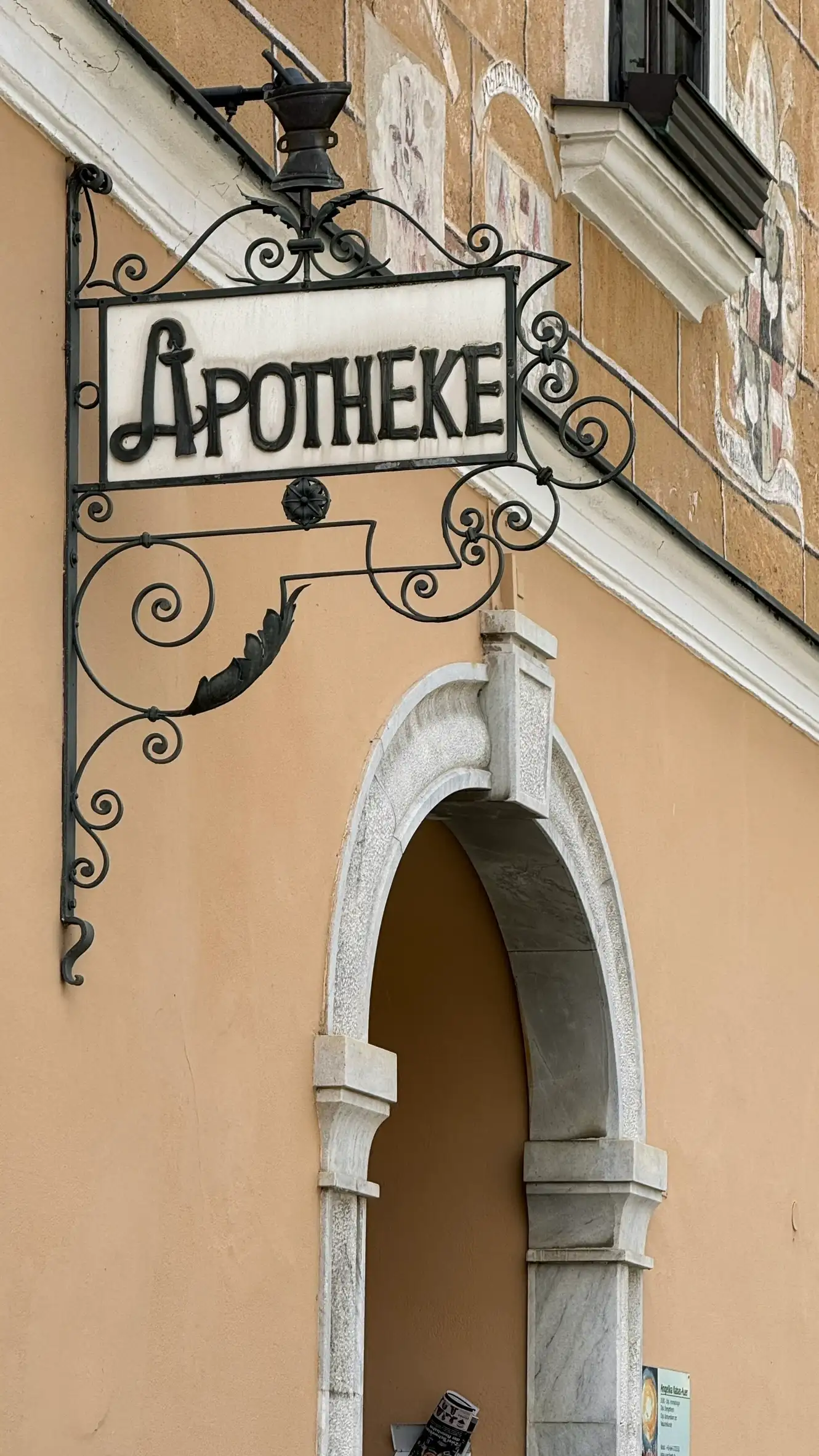
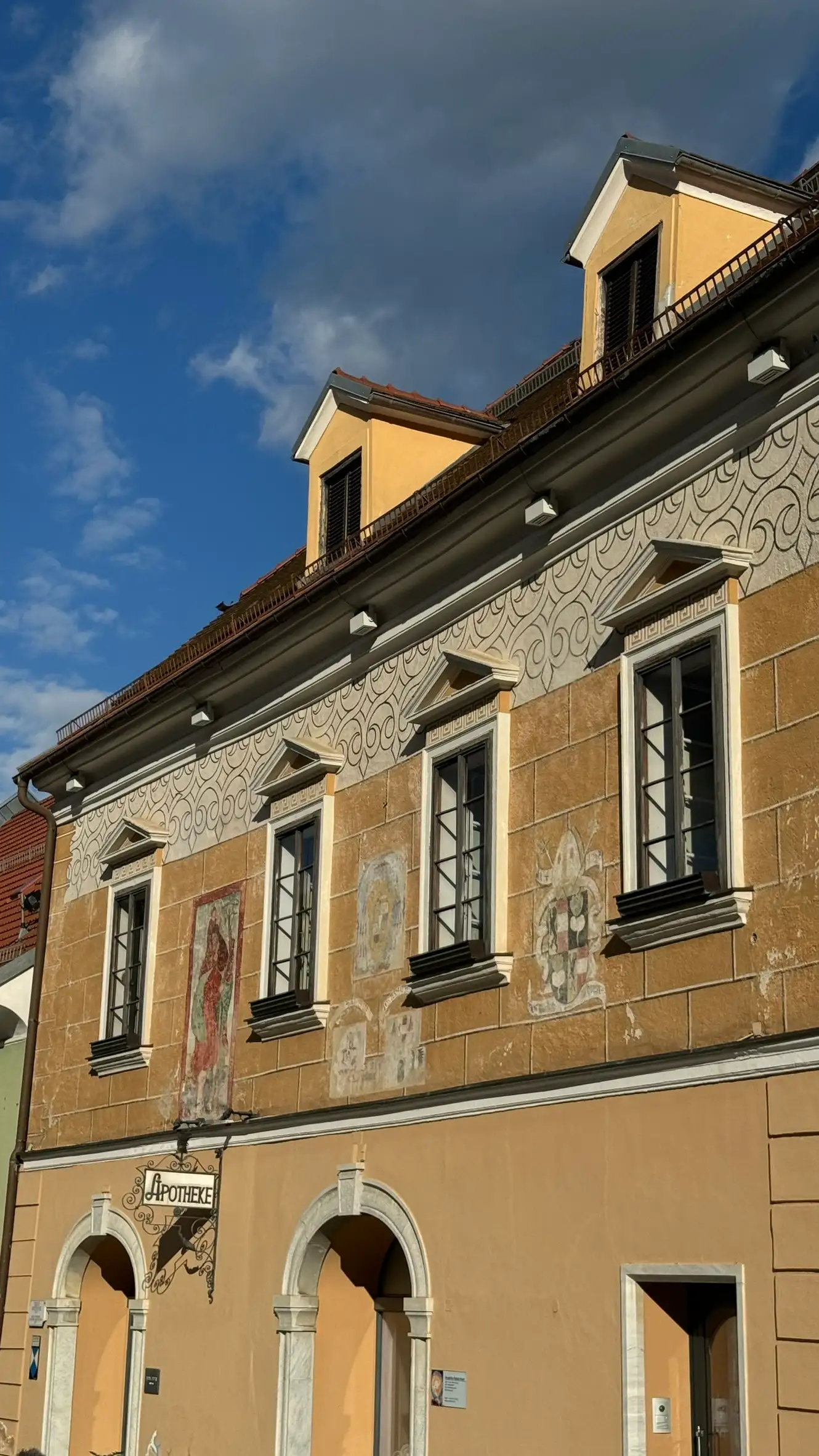
The building at Hauptplatz 7 consists of two adjoining structures. Today, it houses a pharmacy.
History
In the early 18th century, the building served as the municipal town hall.
Since the late 18th century, it has been used as a pharmacy.
Architectural History
The property consists of two structurally distinct buildings.
The eastern house represents a complex whose origins date back to the early 13th century. It underwent several phases of alteration, particularly at the beginning of the 16th century. The most recent remodelling was carried out in 1968.
The western house likewise dates in its original fabric to the 13th century. It was rebuilt at the beginning of the 14th century and remodelled again in the first half of the 16th century.
Architectural Description | Exterior
Eastern Section (rendered in deep yellow)
Horizontal Articulation
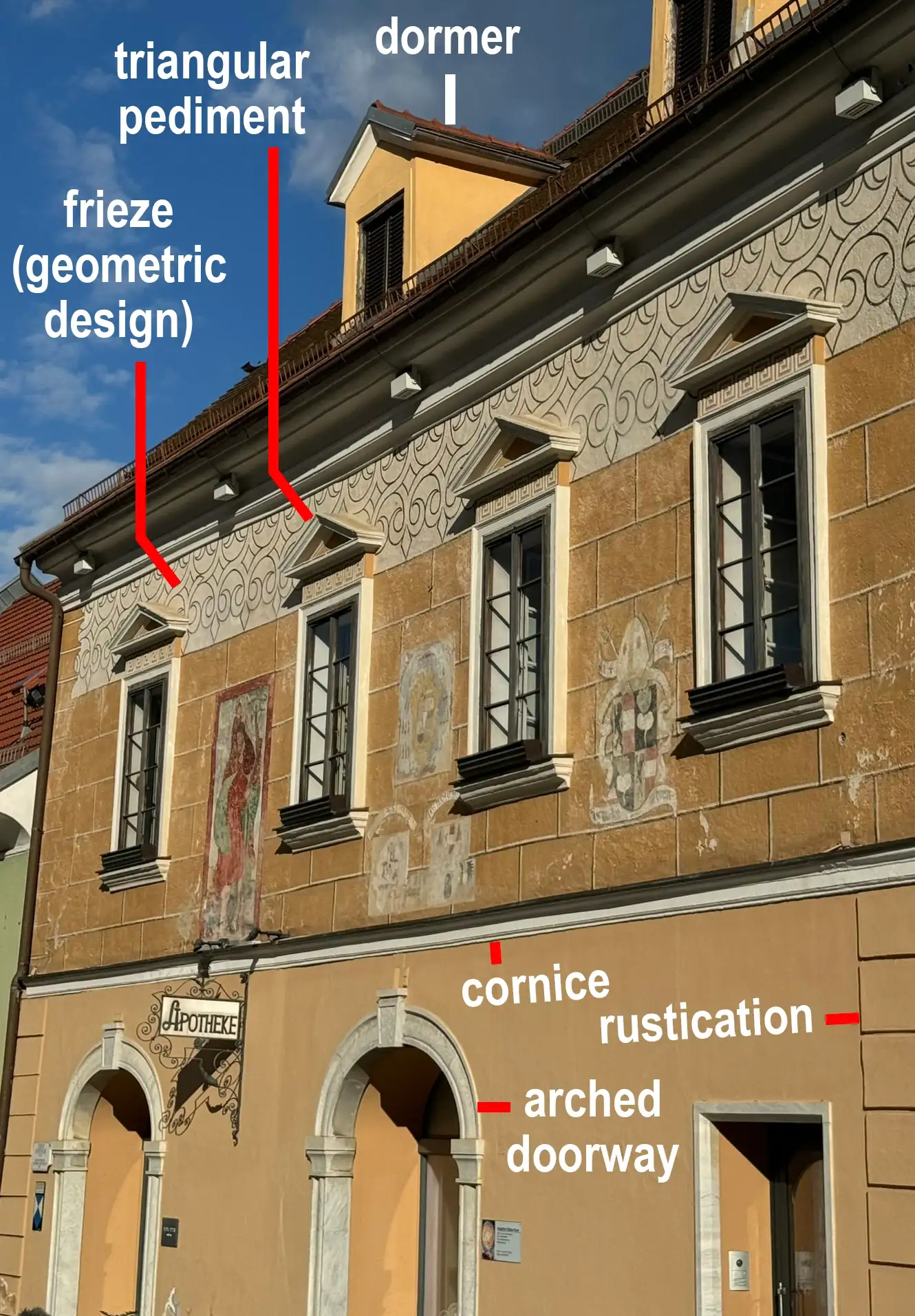
The facade is horizontally articulated by (top to bottom):
– projecting eaves
– prominent soffit
– crowning cornice
– profiled string course
– plinth zone.
Ground Floor
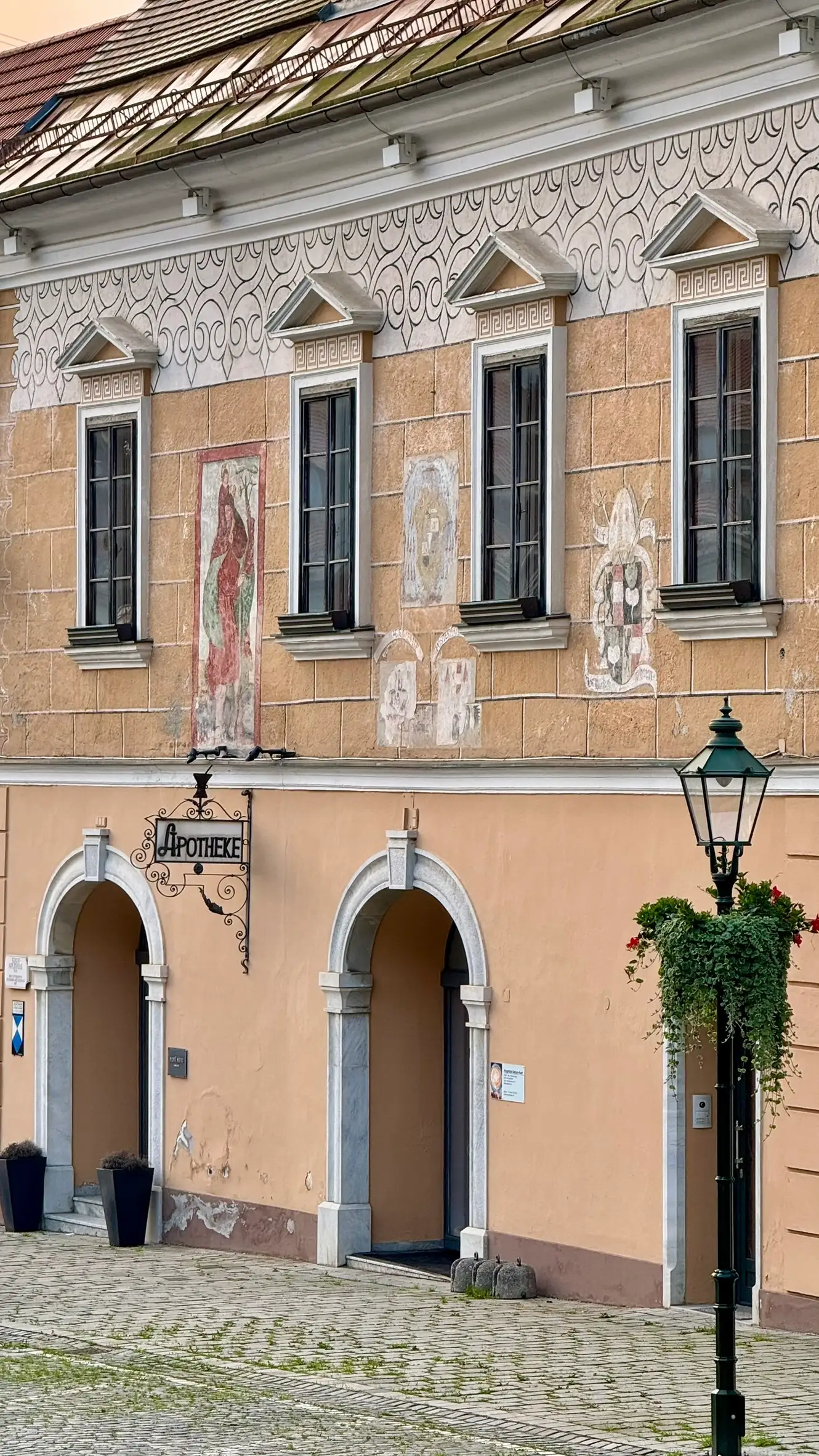
At ground-floor level, the facade edges are accentuated by quoins. Two basket-arched portals with imposts and voussoirs date from 1968.
Upper Floor
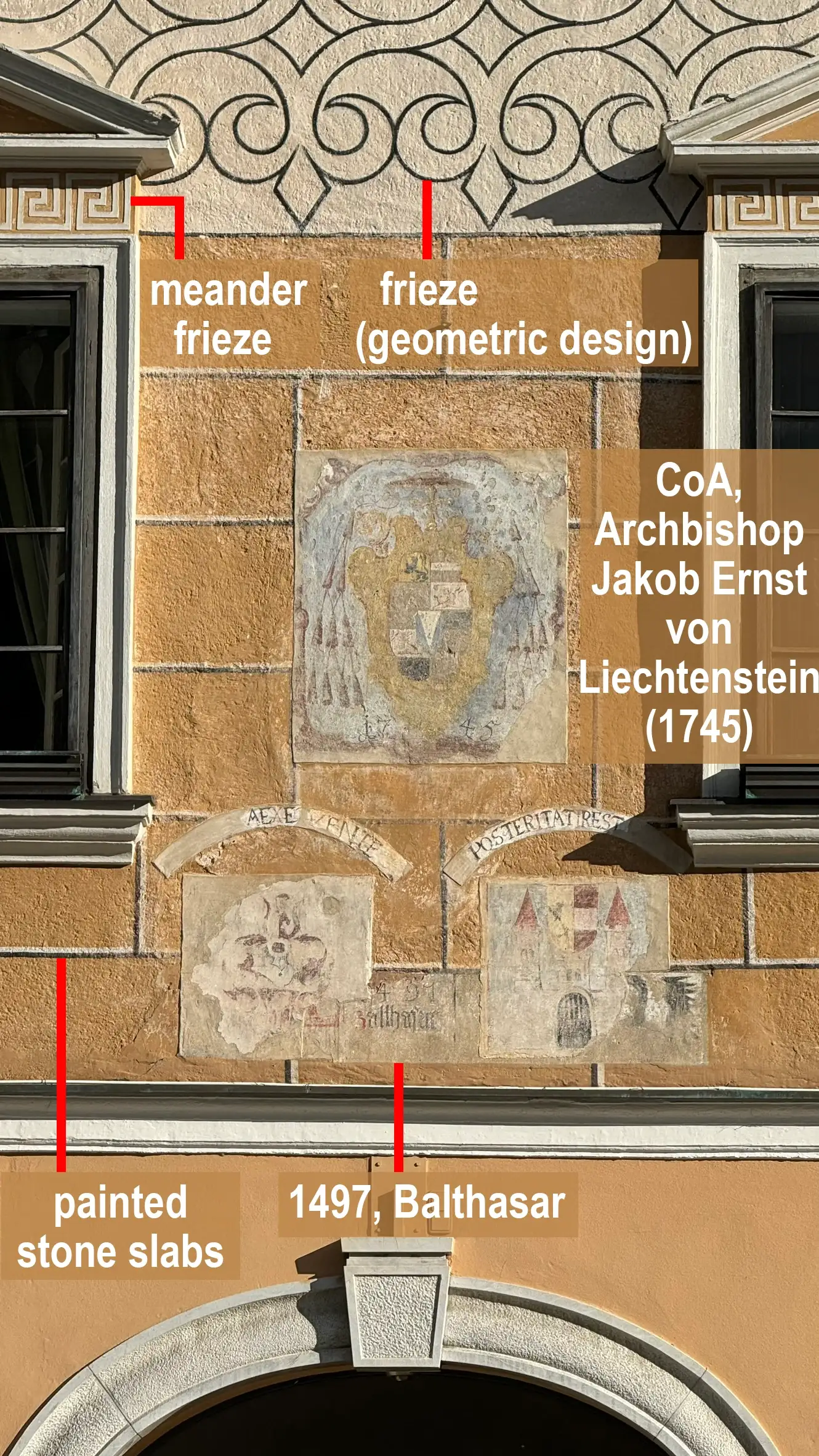
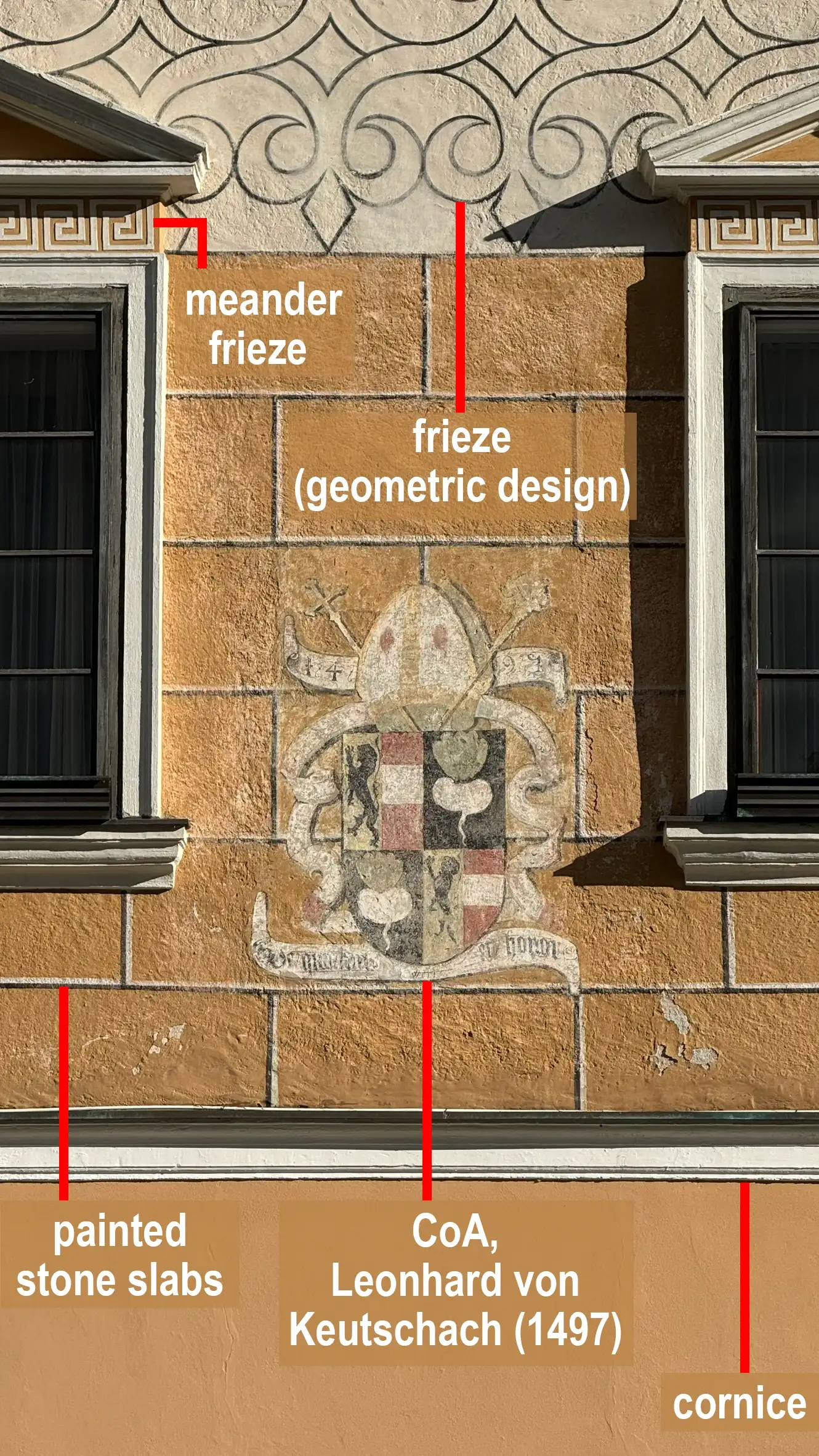
Below the crowning cornice, there is a broad decorative band (frieze) painted with a repeating pattern of crossed lily-shaped curves. The upper-floor facade also features painted blocks that imitate stonework. The upper floor windows are framed by simple surrounds, triangular pediments, and a meander frieze above the lintel, dating from the first half of the 19th century.
Frescoes
Several frescoes survive on the upper floor.
Multiple frescoes are positioned between the window axes.
Description of the Frontal View of the Frescoes
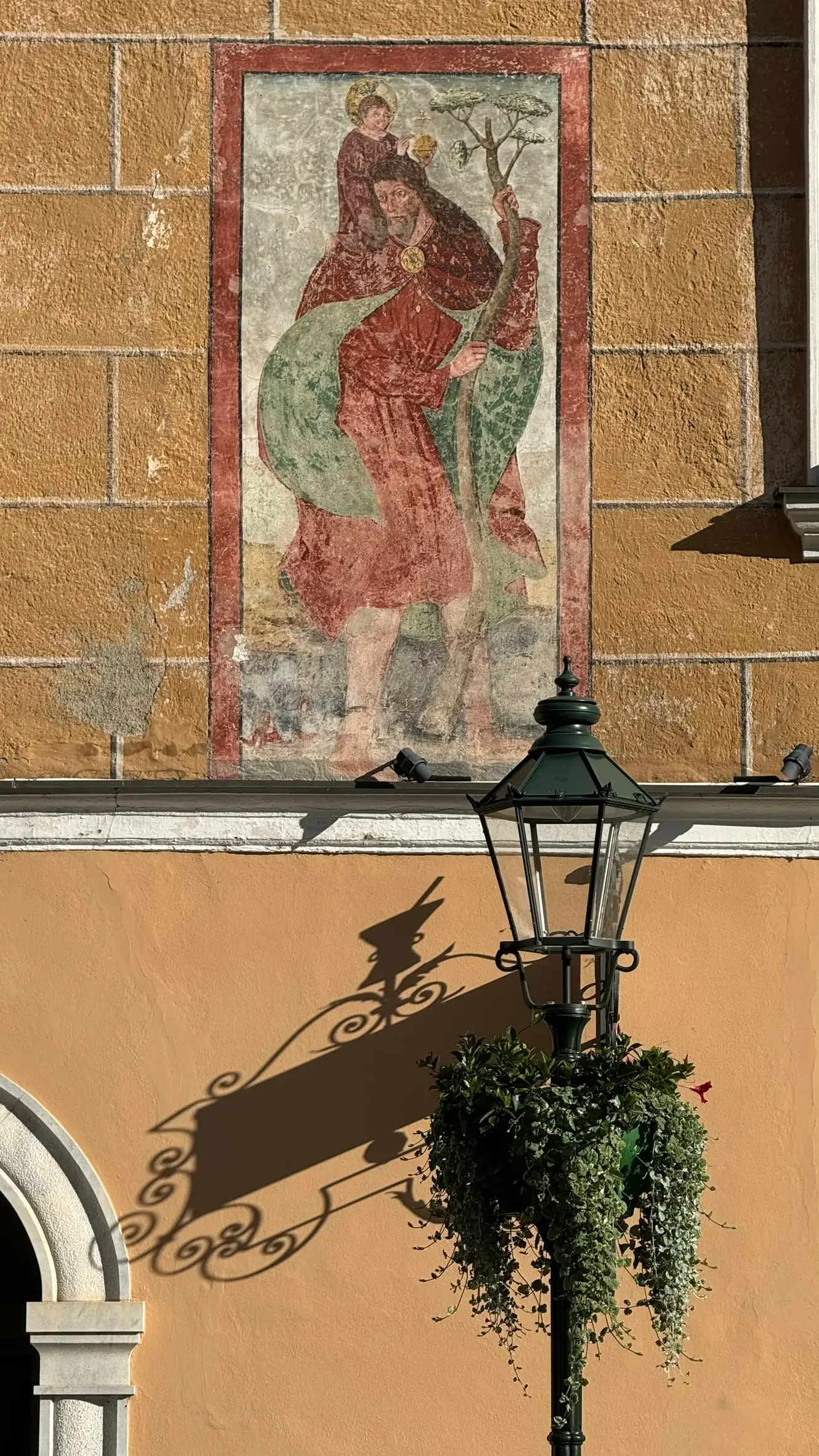
Fresco on the left:
This fresco is a framed representation of Saint Christopher, dating from around 1500.
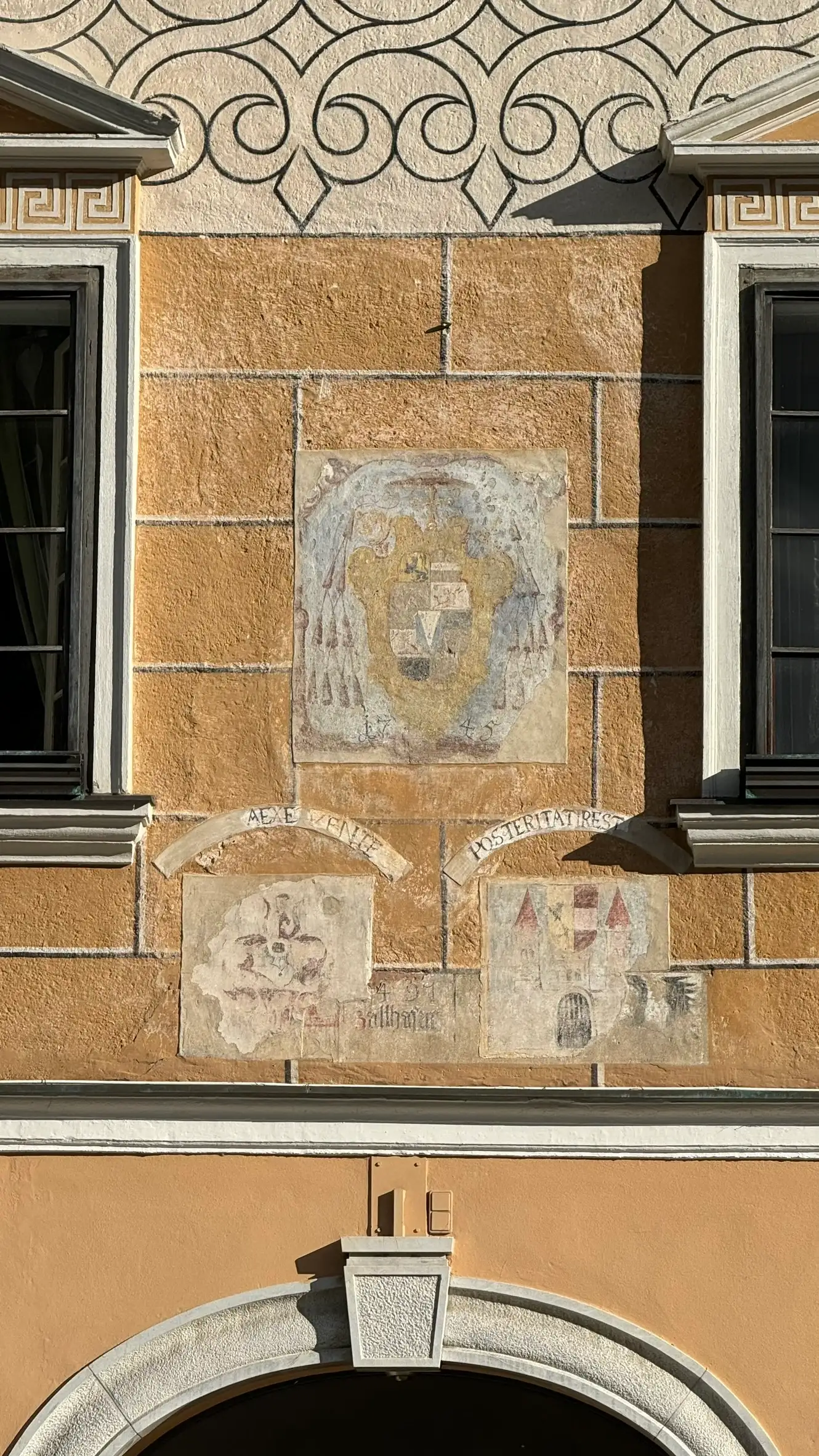
A group of three frescoes in the centre:
At the top is the coat of arms of Archbishop Jakob Ernst Count von Liechtenstein (dated 1745).
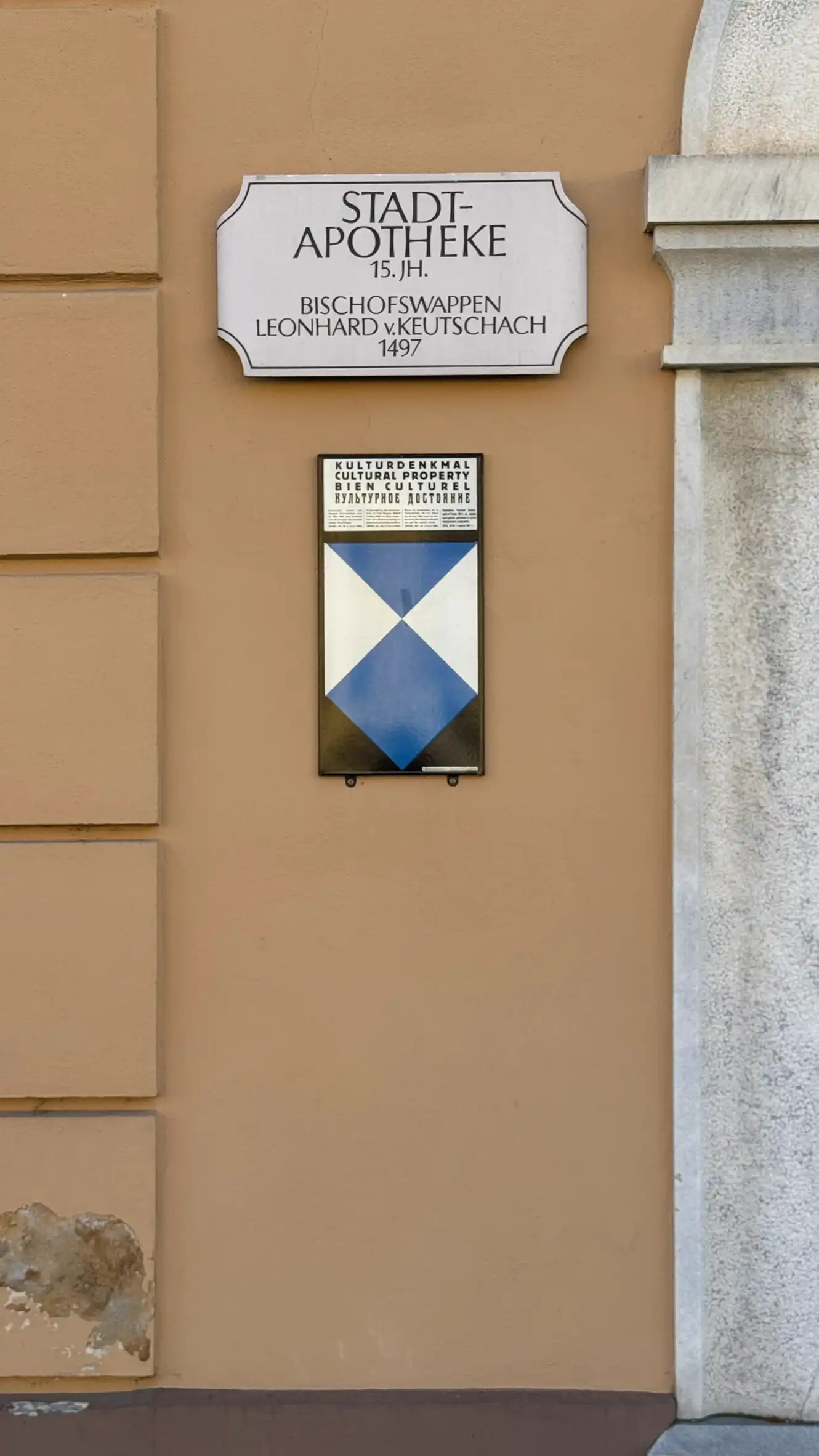
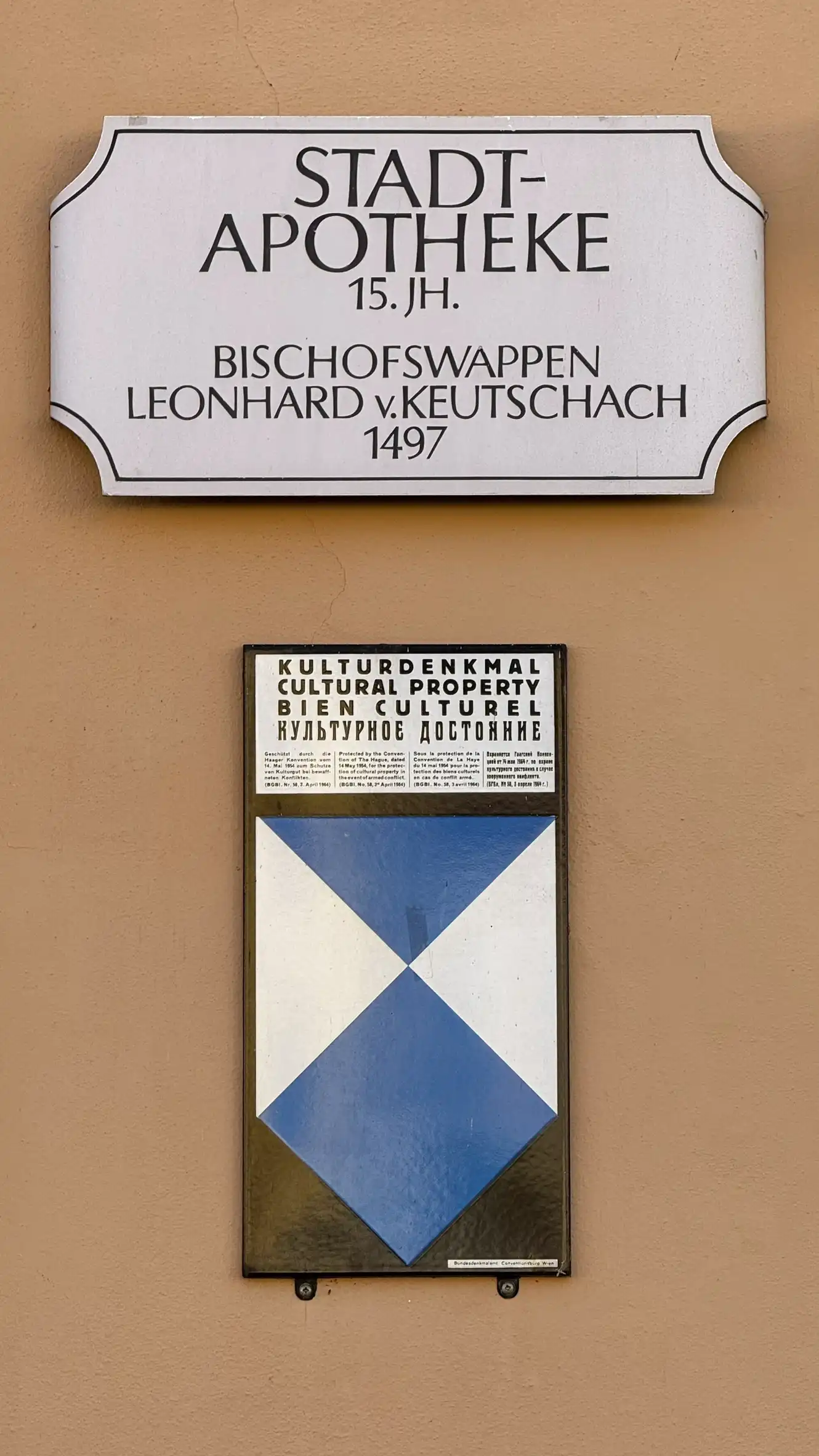
Below this, there are two coats of arms, dated 1497.
The one on the right is the town arms of Friesach.
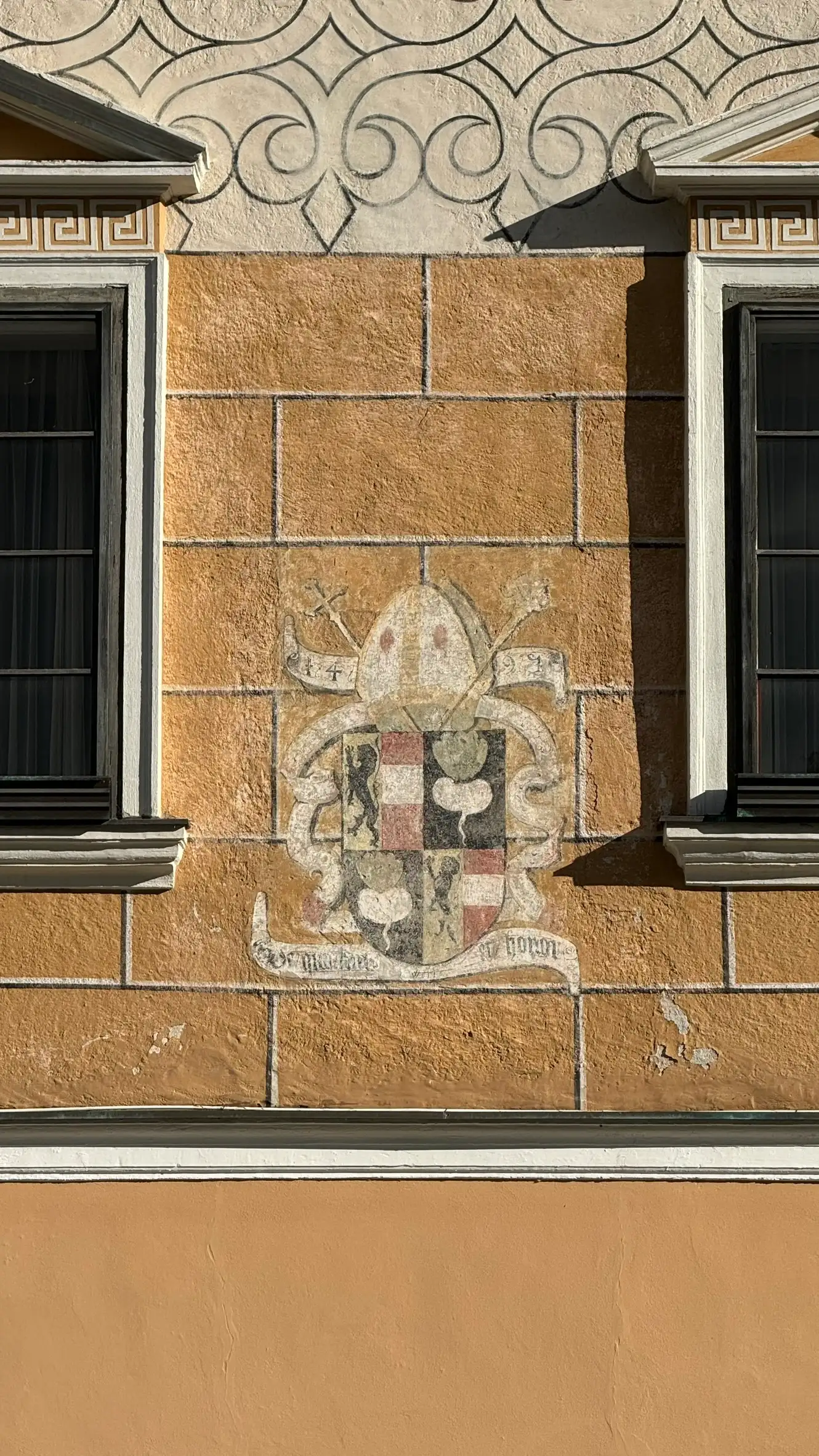
Fresco on the right:
This fresco depicts the coat of arms of Leonhard von Keutschach, and bears the date 1497. It is accompanied by an inscription stating: “This work was commissioned or restored by Leonhard von Keutschach for future generations.”
Western Section
(rendered in pastel greenish-grey)
The windows are fitted with simple surrounds.
On the first floor, they are crowned by triangular pediments.
On the second floor, the window heads are formed by broken basket arches with lozenge motifs, dating from the second half of the 19th century.
A tapering cellar window is secured by a metal grille.
The western edge of the facade is accentuated by quoins.
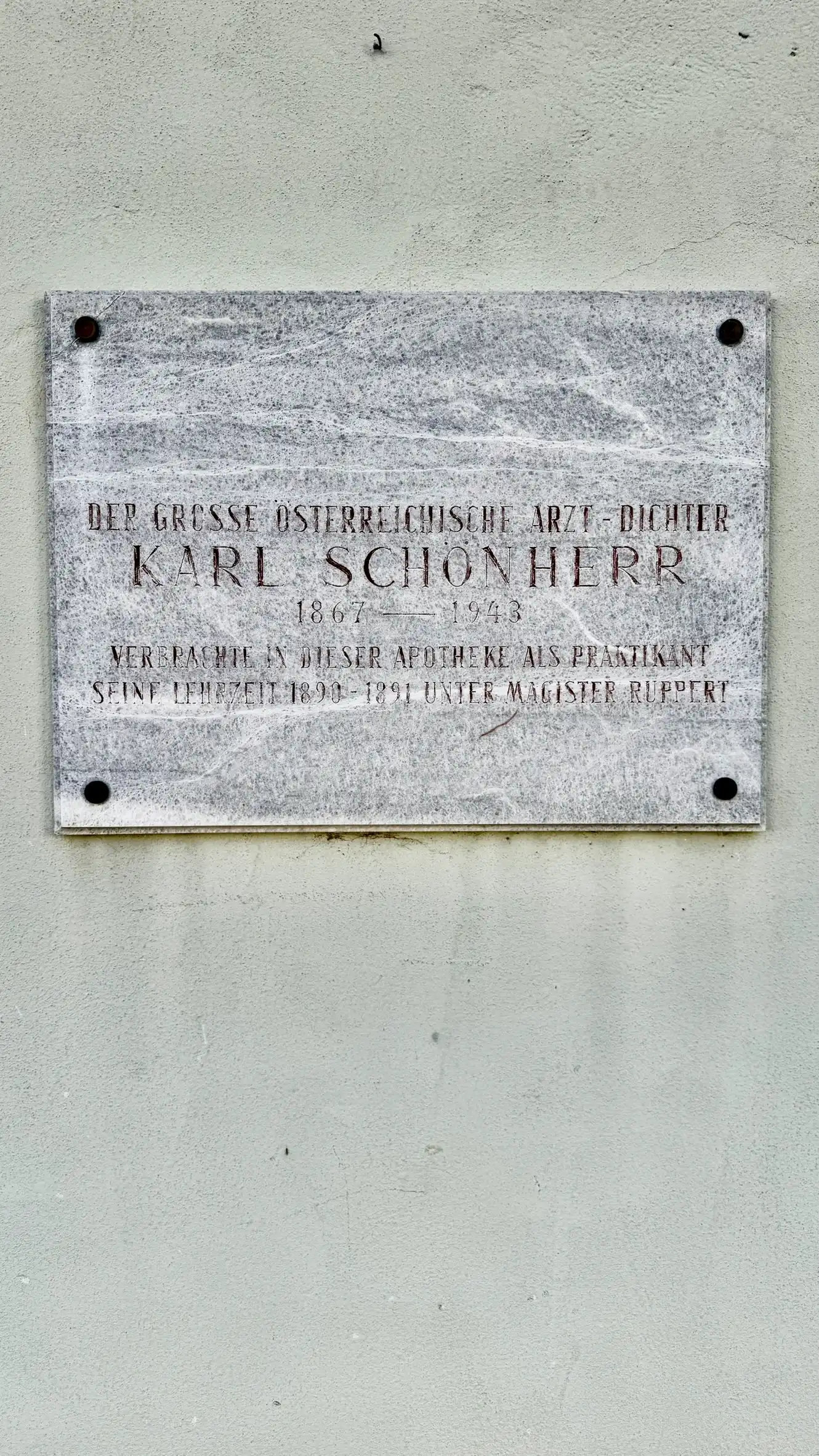
A commemorative plaque recalls Karl Schönherr, physician and writer (1867–1943), who worked here as a trainee in 1890/91.
Roof
A steep pitched roof clad in tiles extends across both sections of the building. It features a fire-wall gable and three roof dormers.
Special Feature
The pharmacy retains its original wooden fittings from the second half of the 19th century.
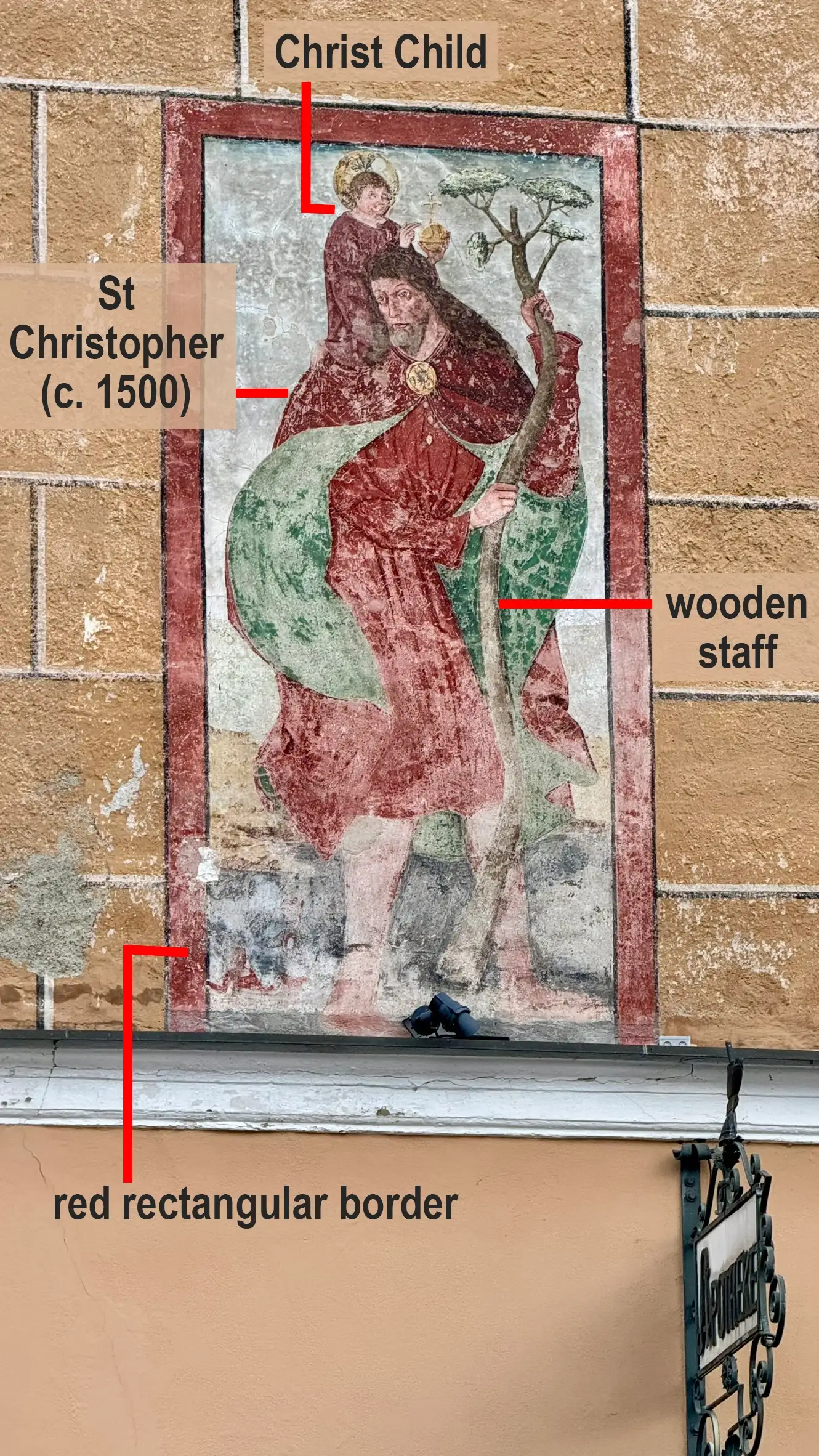
Fresco depicting St Christopher and Christ Child
The fresco on the left dates back to around 1500 and depicts Saint Christopher, a popular saint in Christian iconography known for carrying the Christ Child across a river.
The fresco is framed by a red rectangular border, which encloses the figures of Saint Christopher and the Christ child.
Saint Christopher is depicted with a large staff in hand, standing tall and robust, symbolising his strength and role as a protector. He is carrying the Christ Child on his shoulder, a traditional representation of this saint, who is often associated with safely escorting travellers across dangerous waters.
The figures are painted in muted tones, with Saint Christopher wearing a deep red robe, and the Christ child adorned with a halo, wearing a robe and holding an orb with a cross in one hand. The backdrop is a soft, light green, complementing the earthy tones of the figures.
The fresco, despite some wear over time, retains an aura of reverence and skilful craftsmanship from the Late Gothic period.
Broad Decorative Frieze on the Facade
A continuous horizontal decorative band is visible above the windows of the upper floor and below the roof cornice of the facade. It features a repeated geometric pattern.
Meander Friezes
Four meander friezes are located directly above the upper floor windows and below the triangular pediments. They feature a Greek key pattern.