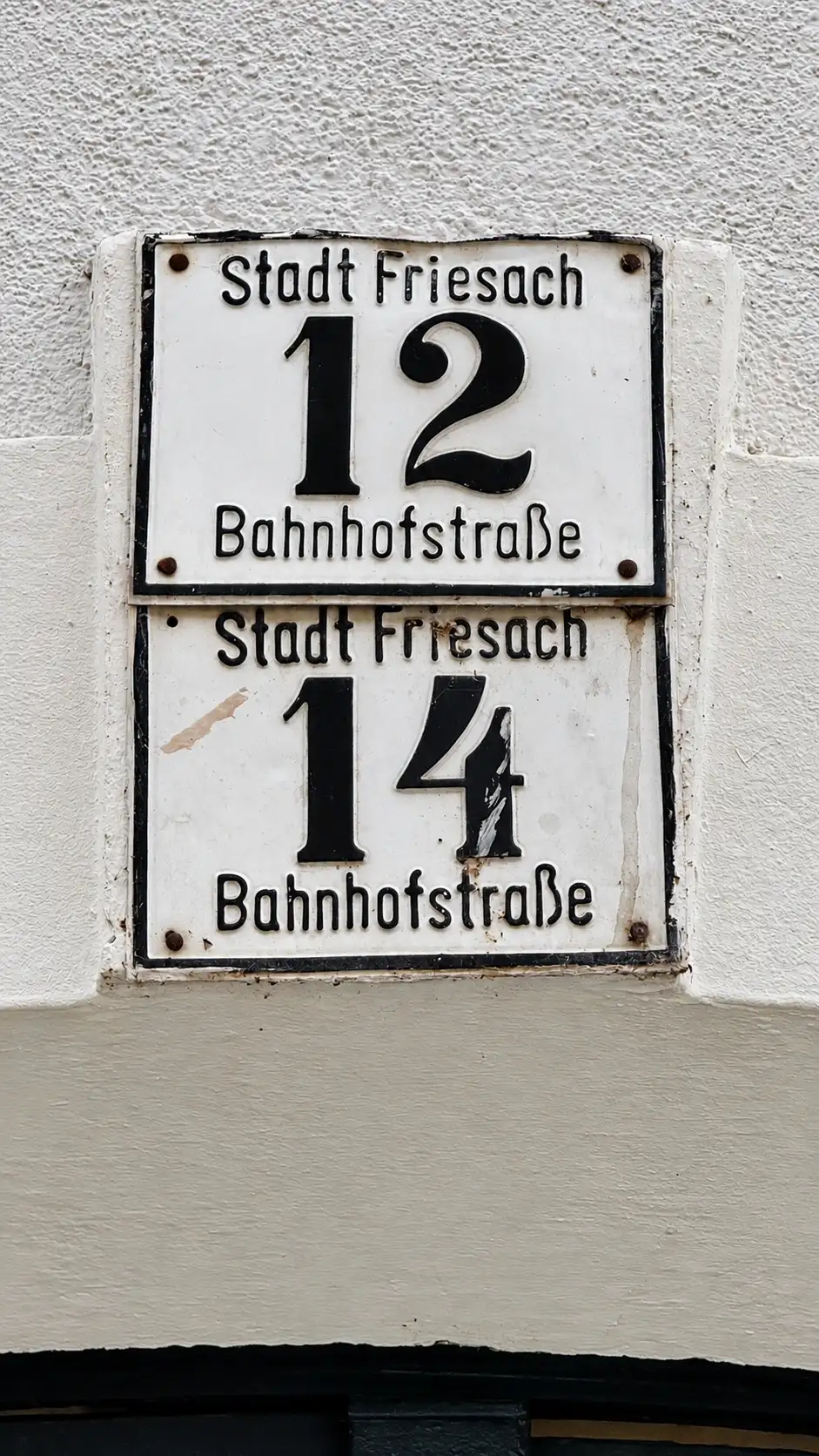
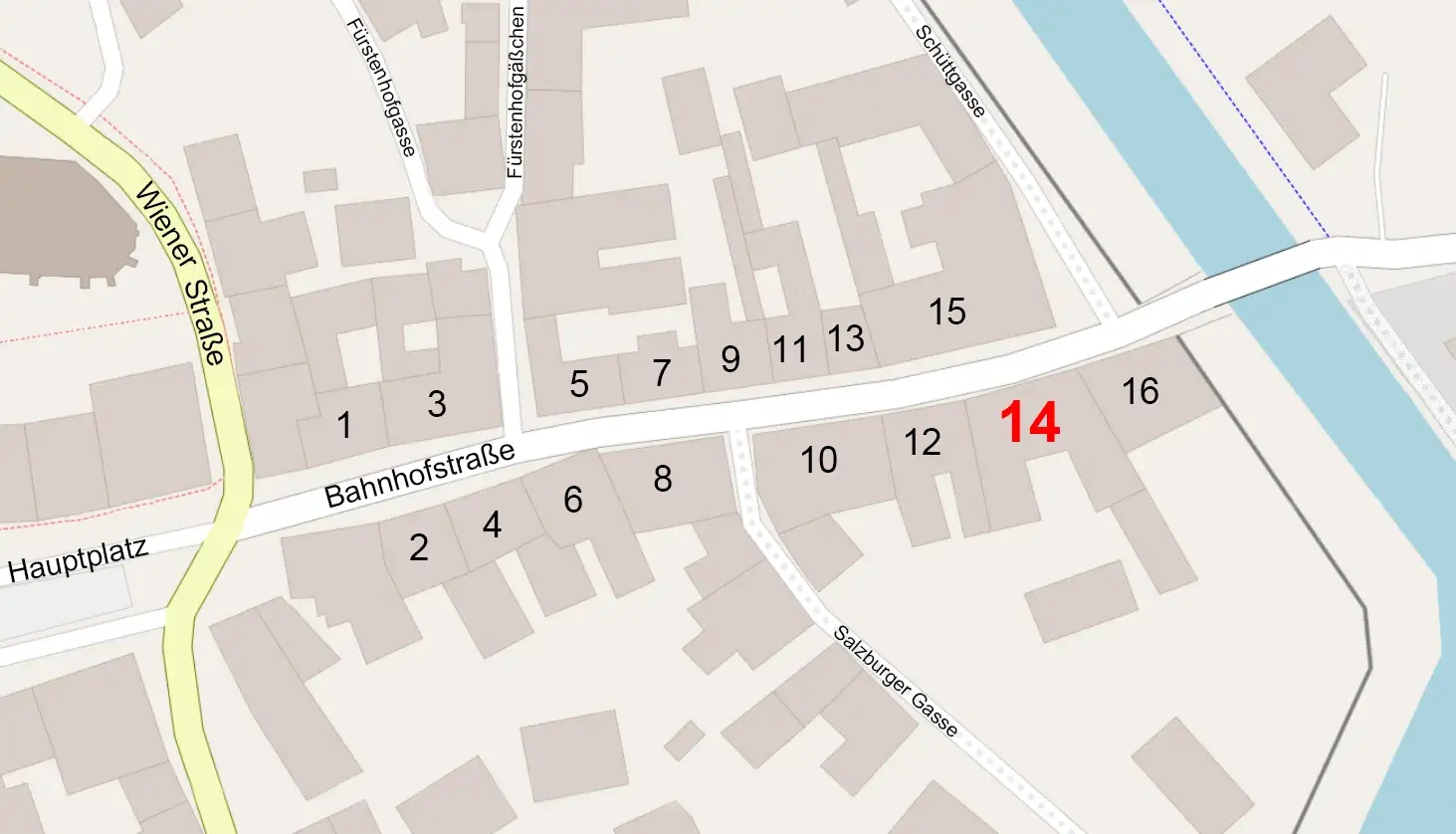
Bahnhofstraße 12–14
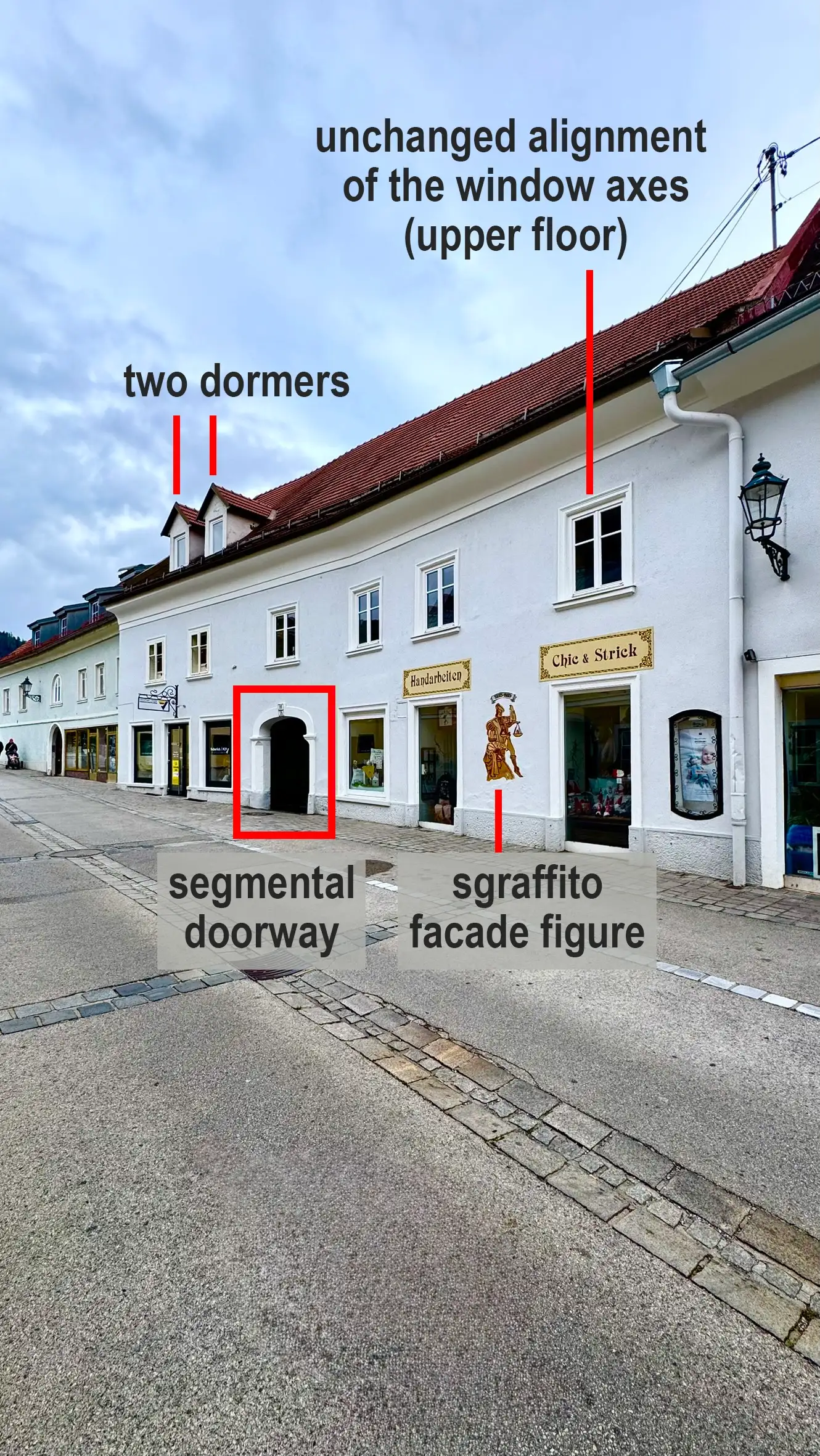
The street-facing sections of the listed building at Bahnhofstraße 14 date back, in their structural core, to the 16th century.
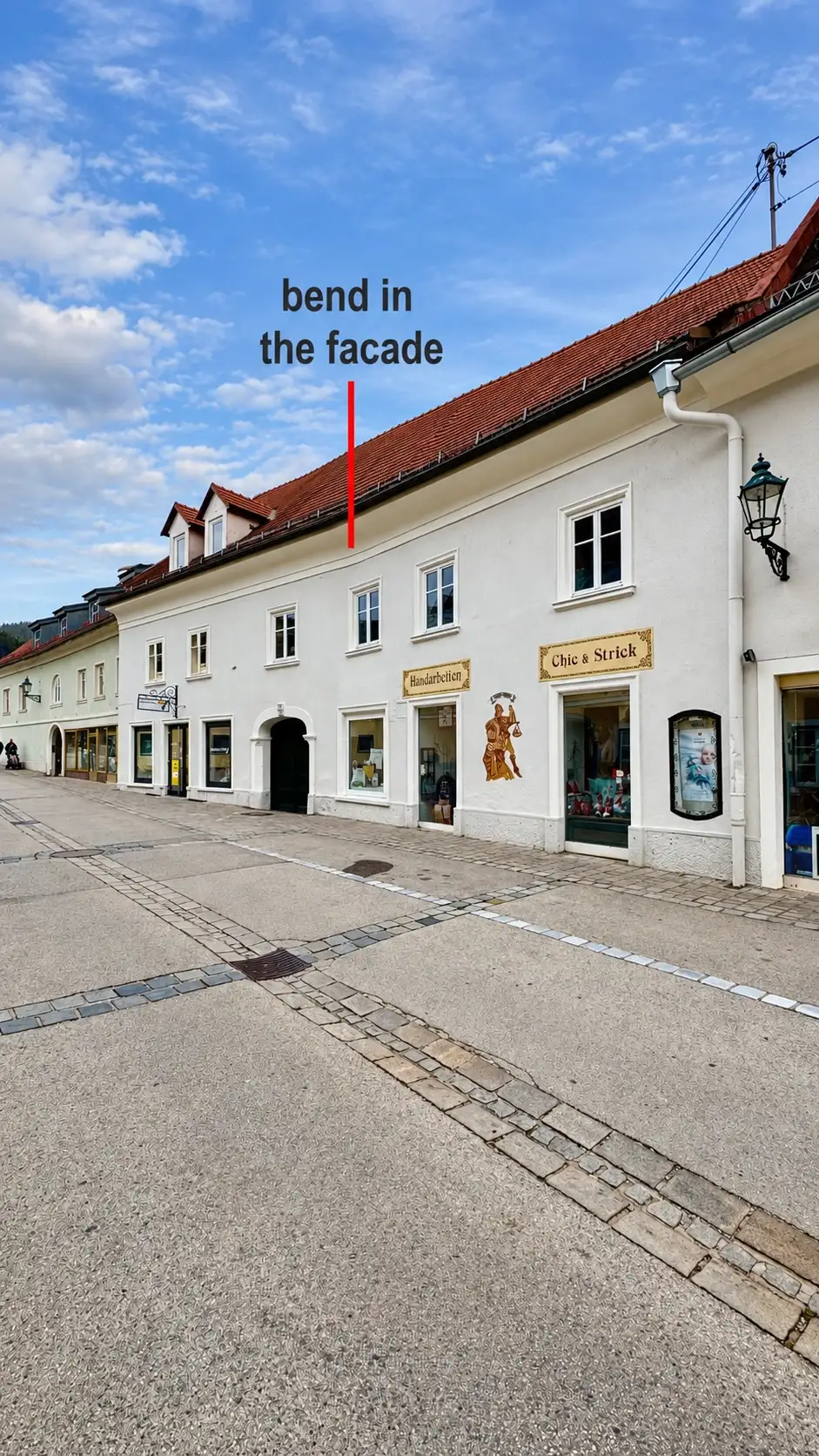
A particularly distinctive feature is the pronounced bend in the facade, which lends the building a somewhat irregular, medieval street presence.
The alignment of the window axes on the upper floor has remained unchanged, preserving the original proportions and overall appearance of the building. In contrast, the ground floor has been remodelled several times.
Despite these alterations, one key architectural element has survived: a barrel-vaulted passageway with a basket-arched gateway. This feature provides clear evidence of the building’s original function as a pass-through structure that gave access to rear storage areas.
More Details
History
Around 1700, the eastern part of the building (formerly No. 17) was owned by the Friesach painter Johann Lidl (tradesperson).
The western section (formerly No. 18) belonged to a master dyer from the late 17th century until the second half of the 18th century.
By 1790, the Friesach painter Johannes Strobl (tradesperson) lived here.
In the early 19th century, the house was in the possession of the Krassnegger painter family.
In 1838, a building permit was issued by the local authorities for the renovation of Bahnhofstraße No. 18.
Architectural History
The complex is formed from two originally separate houses, extending along the curved street line. The core structure dates back to the 16th century.
Following a fire in 1959, renovations were carried out in 1963, 1969, and 1974, shaping the building’s present-day appearance.
Exterior
Street-Facing Facade
The facade is simple, articulated by irregularly spaced window axes and a broad eaves groove.
Windows are framed with modest profiles and prominent sills.
The eastern section has external windows from the 19th century.
The basket-arched portal has a base, guard stones and chamfered pillars from the 16th century.
Wooden door leaves date from the early 20th century.
The shopfront remodelling on the ground floor was carried out in the 1960s and 1970s.
Courtyard-Facing Facade
The courtyard facade in the west features simple wooden balconies from the 19th century.
17th-century pillar arcades remain partly preserved on the ground floor.
Roof
The gabled roof features two small street-facing dormers. The gable functions as a firewall.
Interior
The entrance passage has an irregular barrel vault with small transverse ribs from the 16th century.