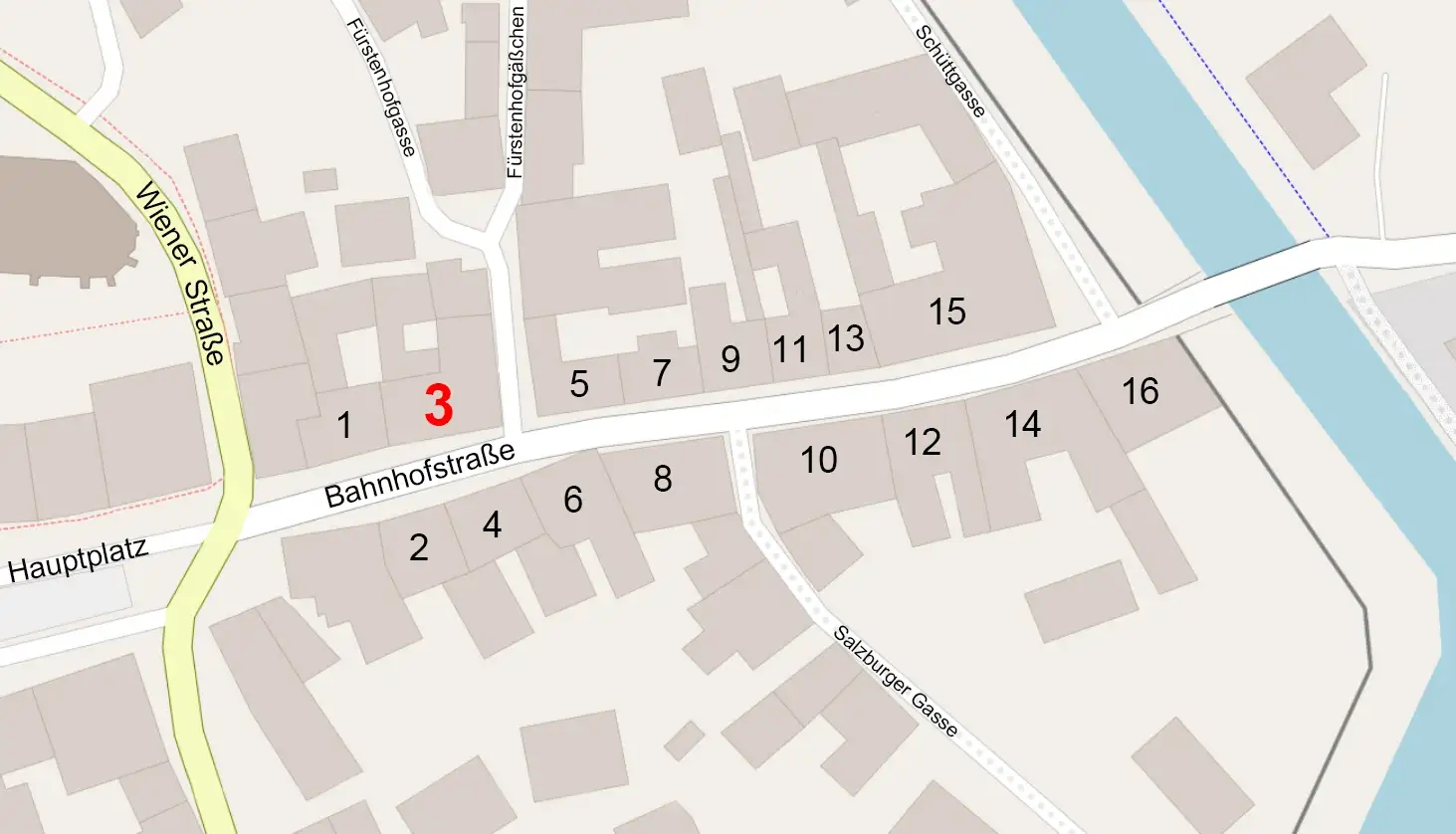
Bahnhofstraße 3
Traditional Inn
History
Mid-18th Century
Around the mid-18th century, the building was owned by a furrier.
1796
There was a Bockwirth at this location in 1796.
The term “Bockwirth” refers to a beer tavern keeper.
Bockwirth (Old German) | Bockwirt (Modern German)
1797
In 1797, it housed a military hospital for Austrian and French wounded soldiers.
1895
The Köppl family acquired the building in 1895 and have retained ownership to the present day.
1945
In 1945, it housed a British non-commissioned officers’ mess.
Ground Plan
The building has an L-shaped ground plan.
Partial Rebuilding Around 1900
The corner building was partly rebuilt around 1900. Medieval structural fabric was incorporated into the north wing.
Street-Facing Facade
Neoclassical Design
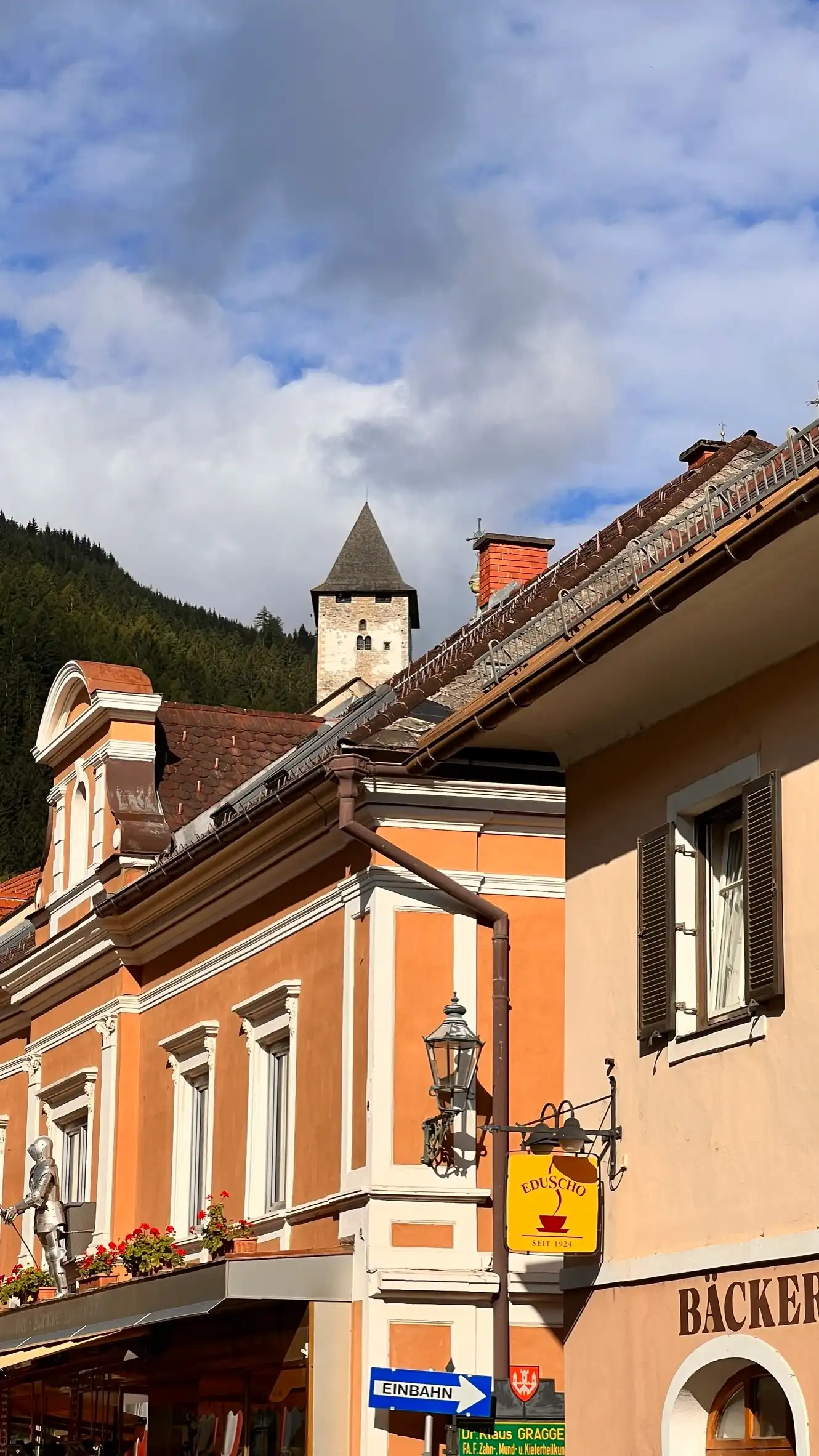
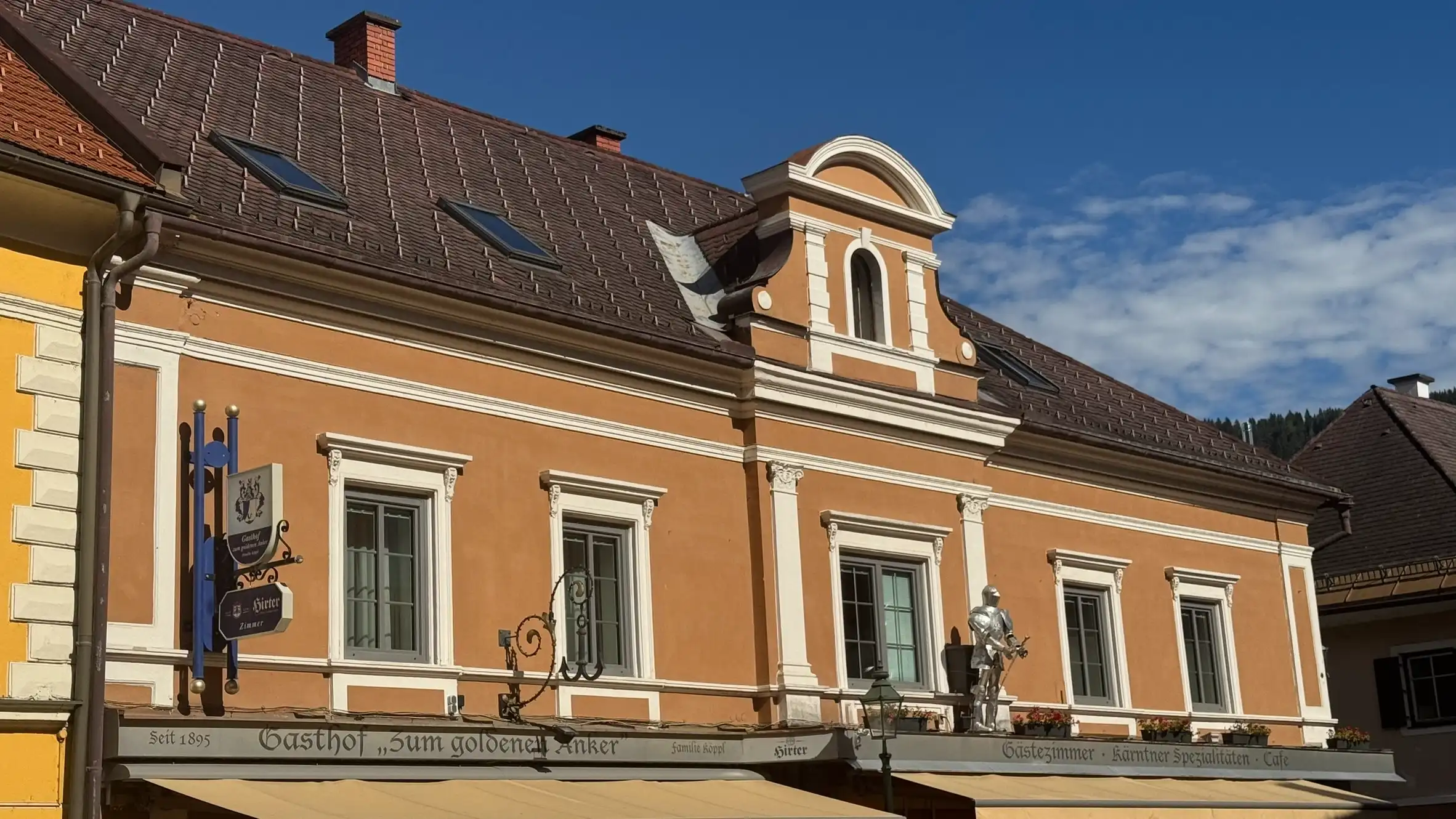
The townhouse impresses with its representative facade influenced by Neoclassical design.
Storeys
The elongated street-facing facade is divided into two storeys and has an additional attic level.
Rendering
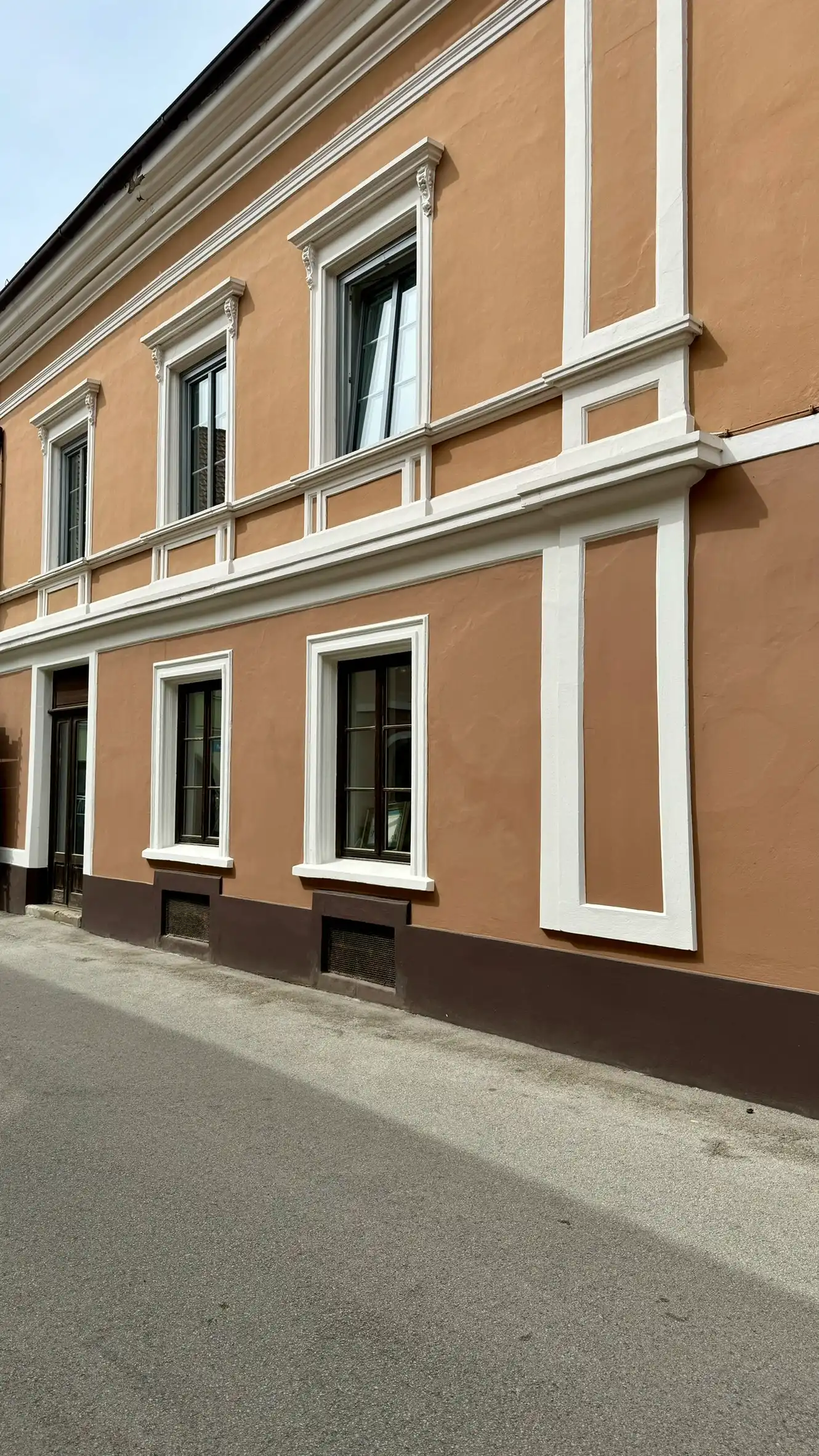
The building is painted in a peach-ochre tone, highlighted by crisp white plaster detailing.
Facade Articulation
The facade is horizontally articulated by cornices and a moulded sill course. It is framed laterally by pilaster strips.
Ground Floor
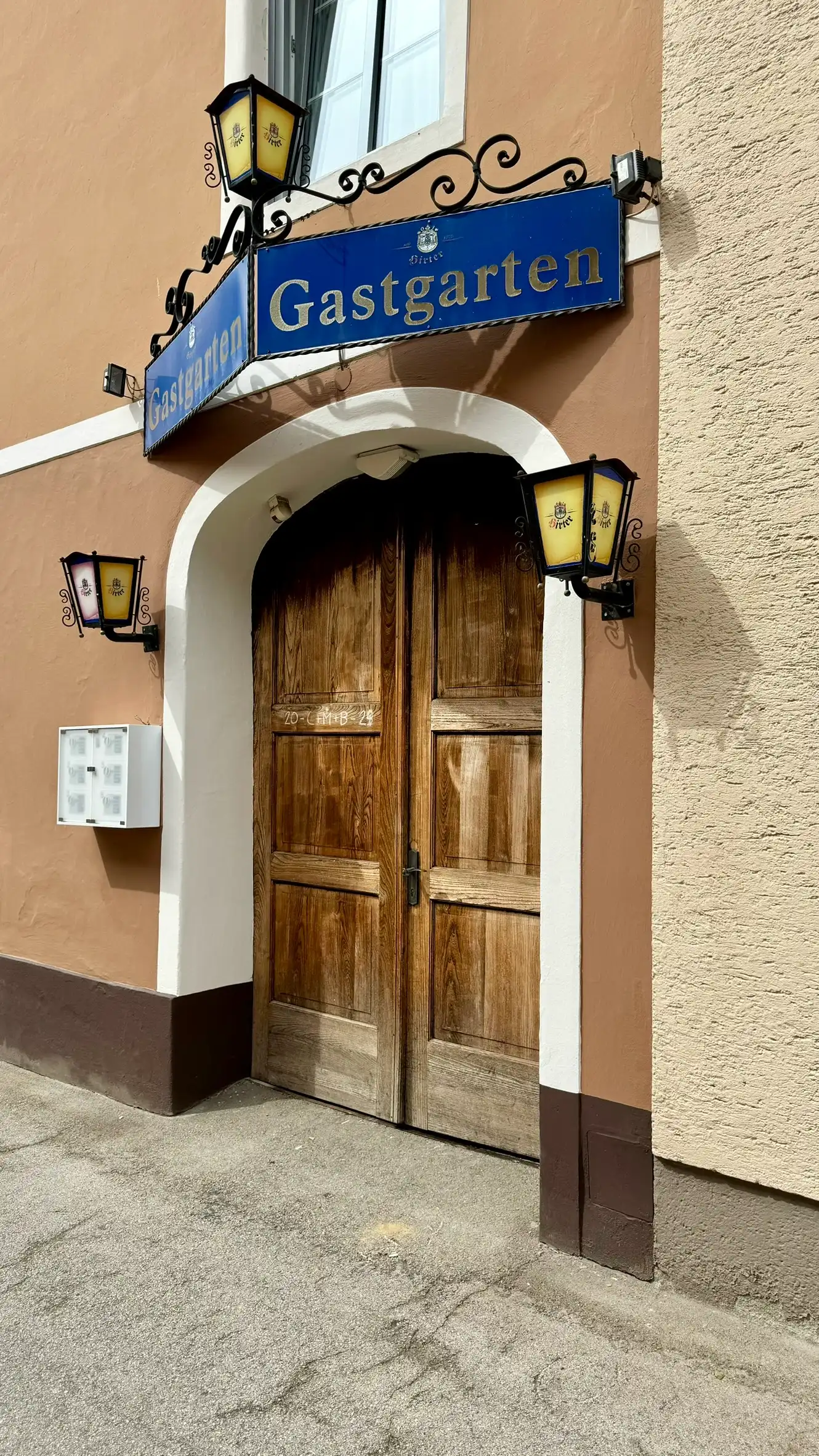
In 1968/69, the ground floor was remodelled to accommodate the increasing demands of the inn and restaurant. At street level, door openings connect the interior with the public space. Large rectangular window openings provide light to the interior.
First Floor
The first-floor windows have moulded plaster surrounds with straight window heads supported by brackets.
Central Risalit
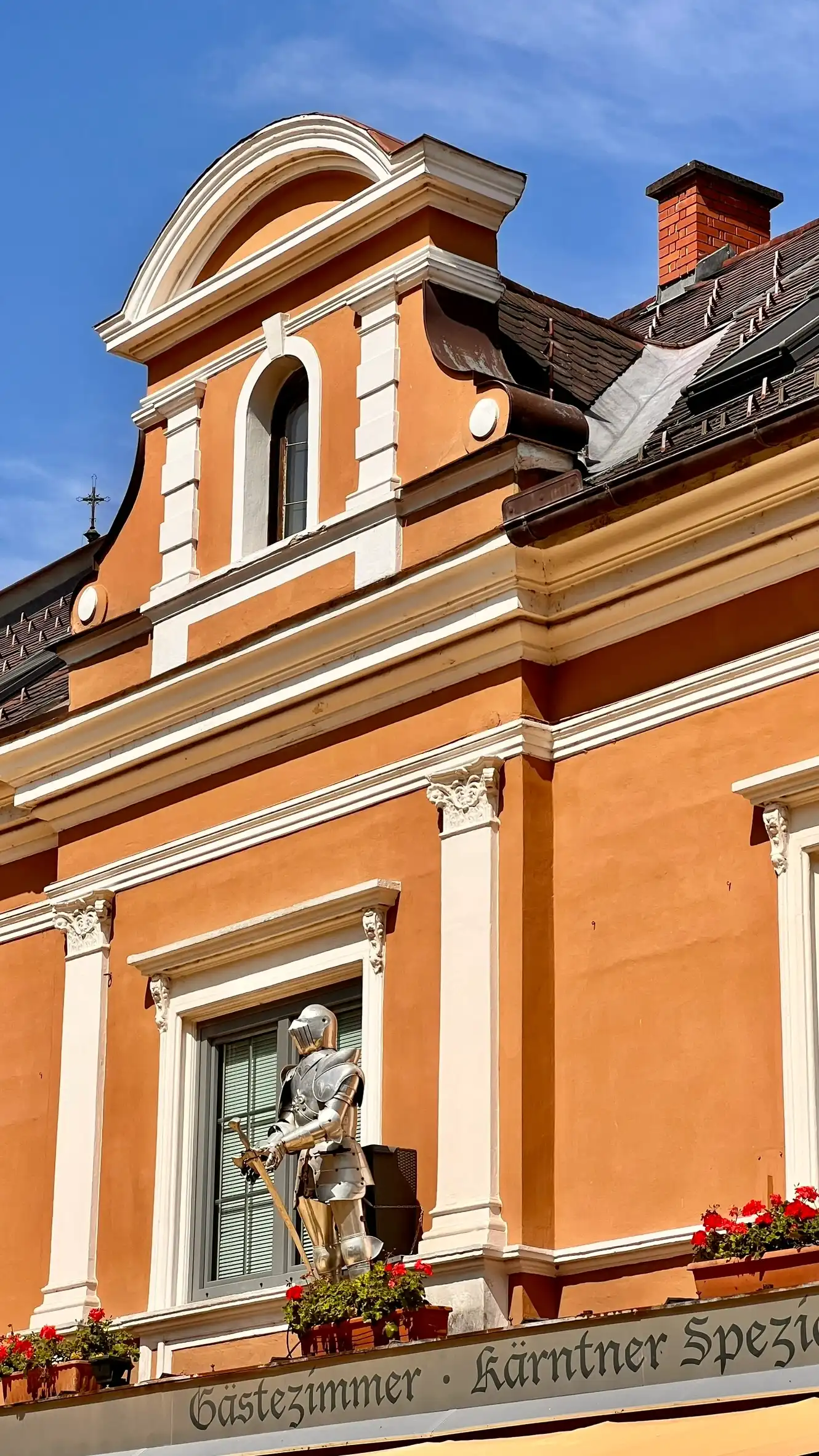
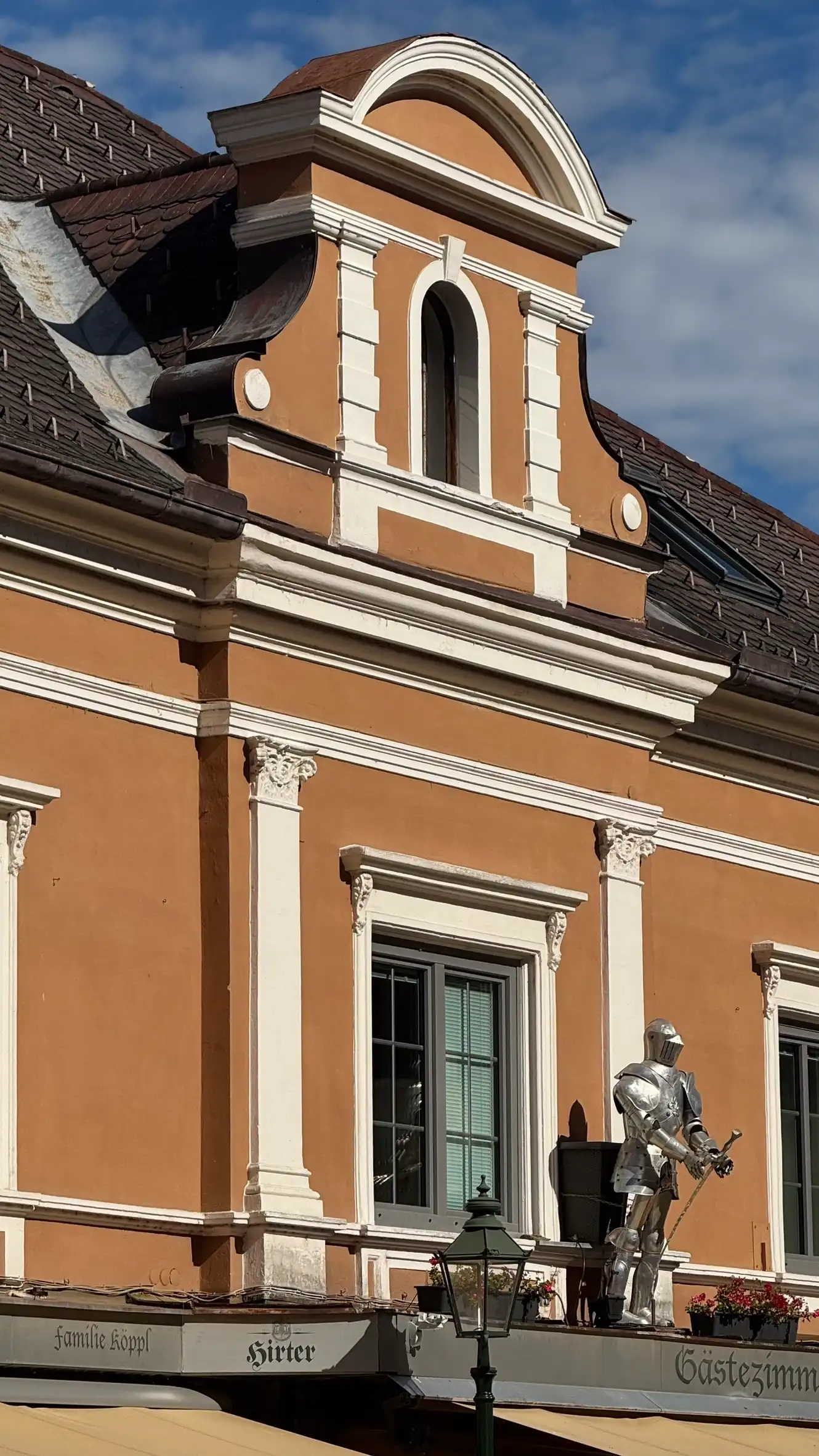
Facing Bahnhofstraße, the central axis of the facade features a single-bay risalit crowned by a gable. The gable has a central round-arched window, flanked by banded pilasters. A moulded cornice rests above the round-arched window. The gable terminates at the top in a round-arched pediment. There is a moulded white rectangular frame positioned between the round-arched window above and the cornice of the projecting risalit below. At the first-floor level of the risalit, there is a large rectangular window flanked by white flat pilasters, dating to around 1890. A striking feature is the knight figure also mounted at first-floor level, which lends the building a distinctive character.
Traditional Inn Sign
A wall-hung projecting sign recalls the long-standing gastronomic use of the property, which has borne the name “Zum Goldenen Anker” since 1895.
Courtyard Facade
On the courtyard facade, timber Pawlatschen (open wooden galleries) from the late 19th century survive.
Arched Gable
Labelled Features
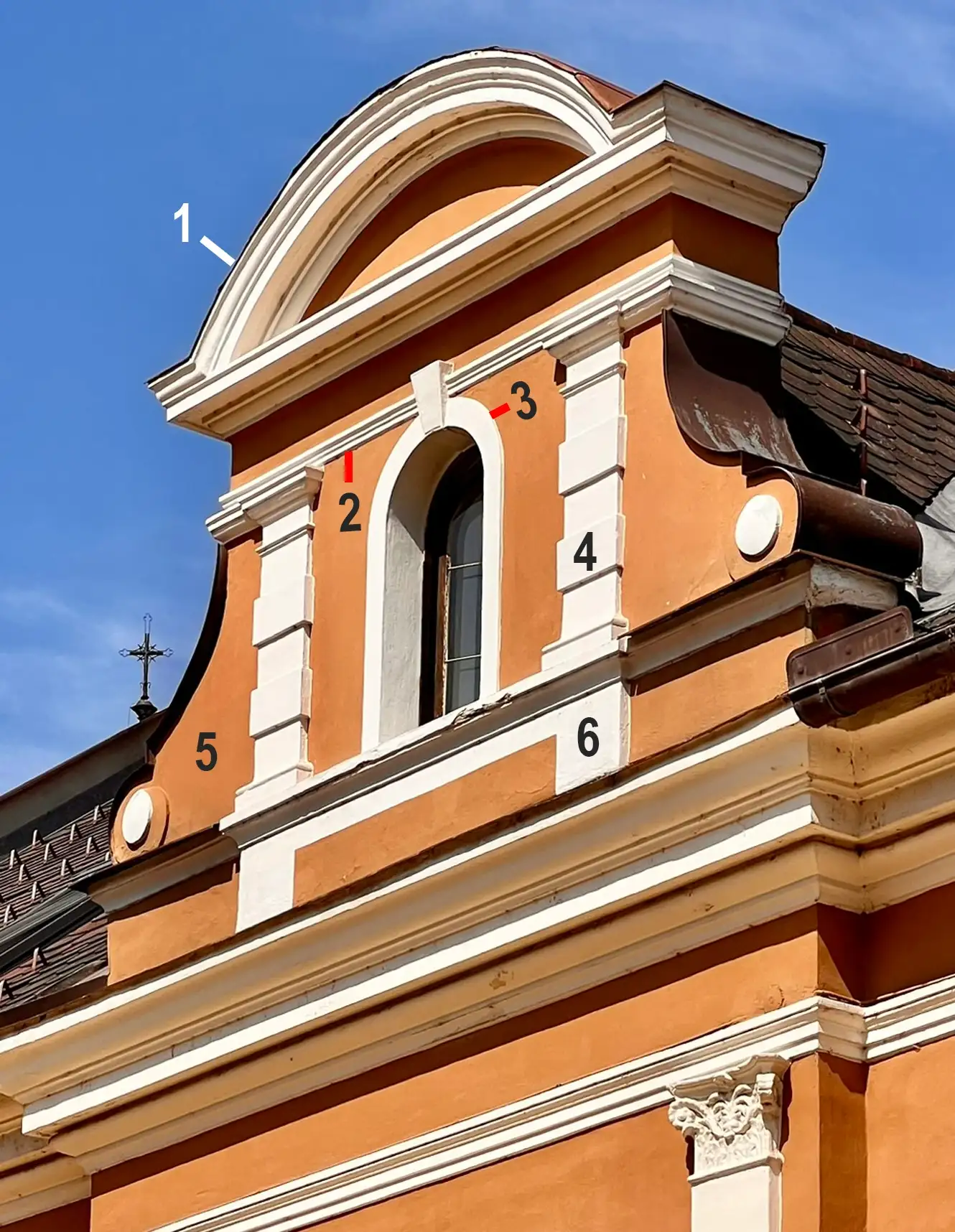
1 arched gable pediment | 2 string course |
3 arched window surround | 4 rusticated pilaster |
5 curved gable wing | 6 rectangular plaster panel
South Facade Articulation
Labelled Features
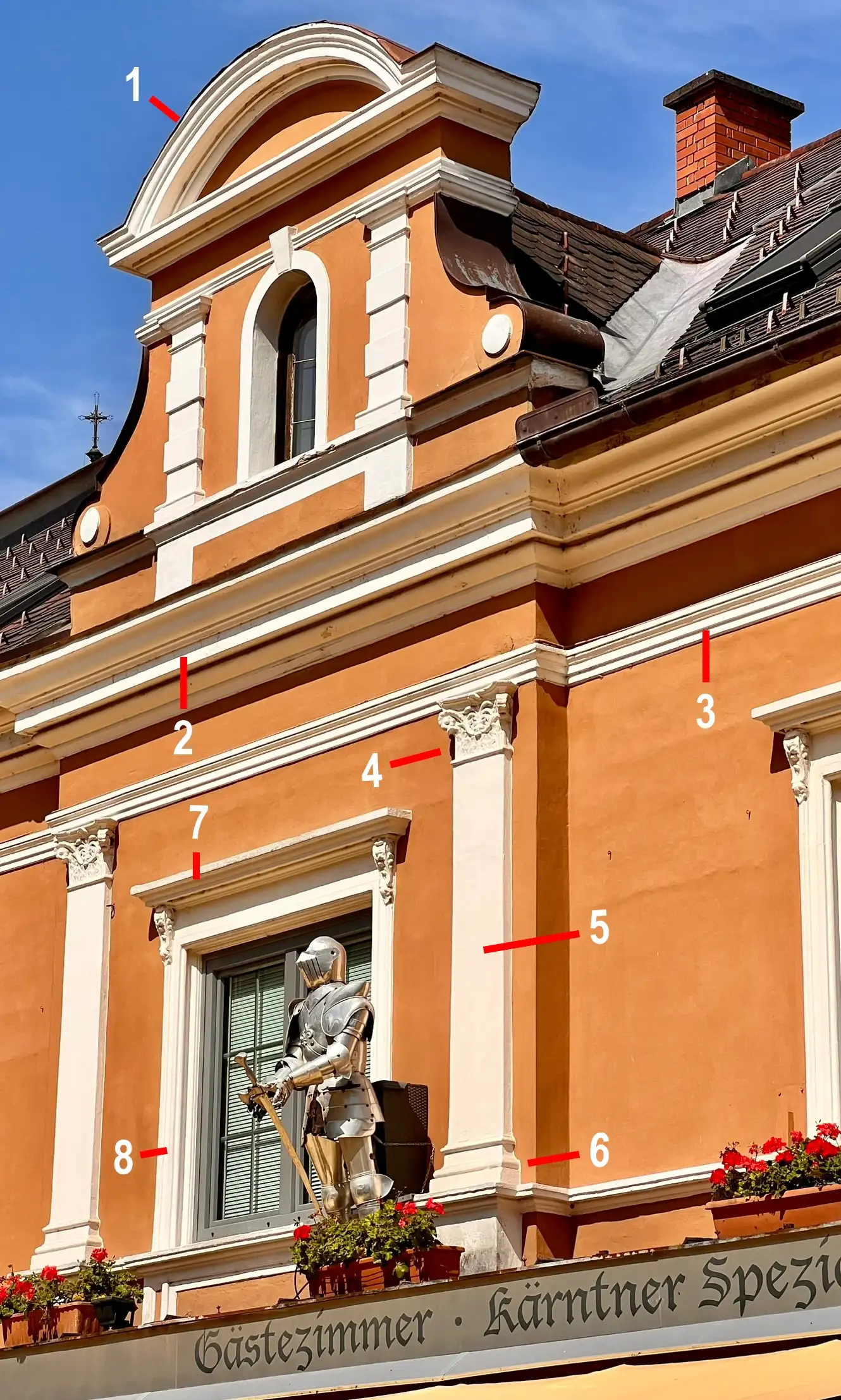
1 arched gable pediment | 2 roof cornice |
3 string course | 4 decorated pilaster capital |
5 pilaster shaft | 6 pilaster base |
7 window pediment | 8 window surround
Horizontal Articulation
East Facade facing Fürstenhofgasse
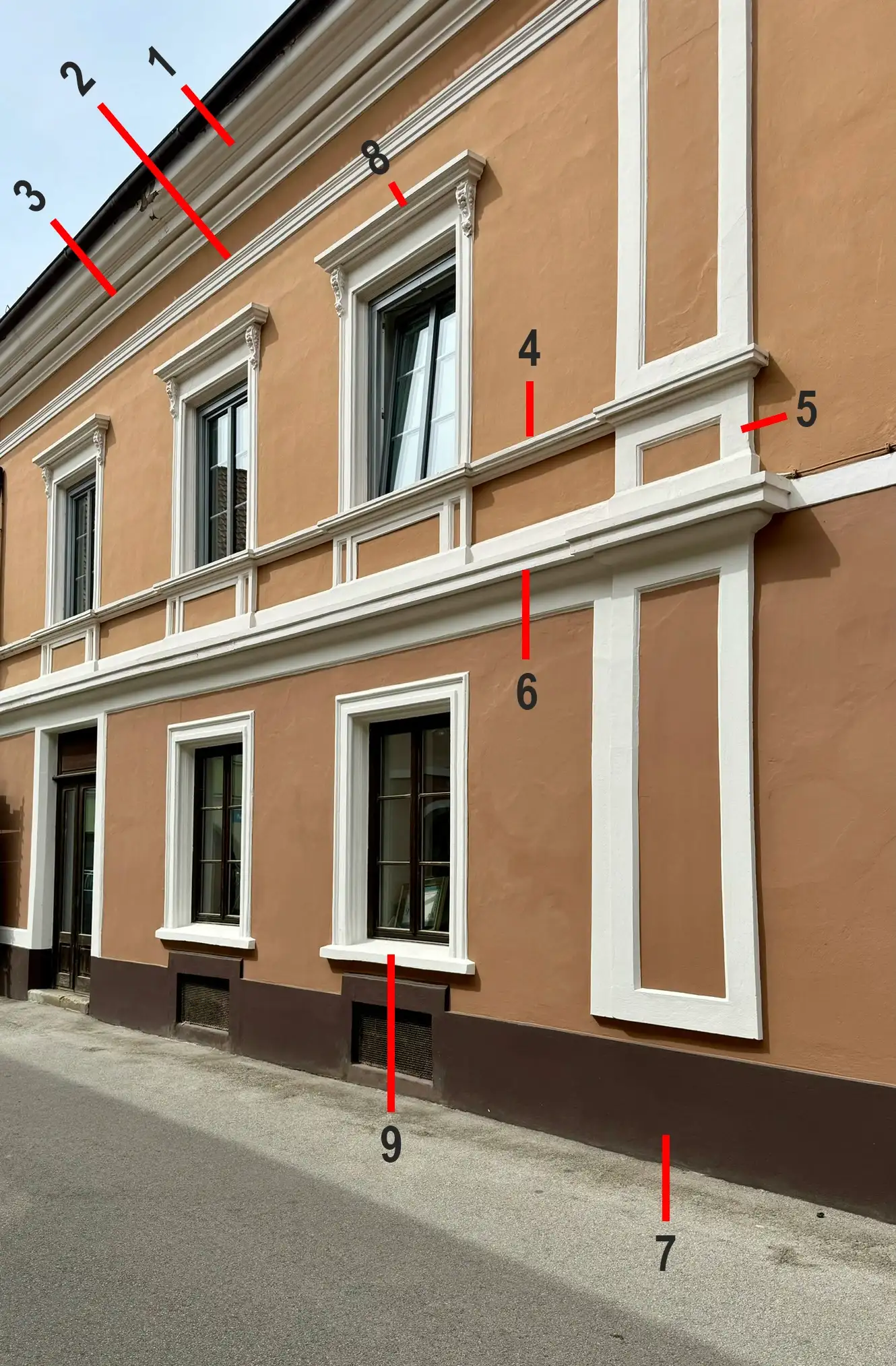
1 soffit | 2 string course |
3 roof cornice | 4 sill course |
5 rectangular moulding, horizontal orientation |
6 cornice | 7 plinth course |
8 window pediment | 9 window sill
Vertical Articulation
East Facade facing Fürstenhofgasse
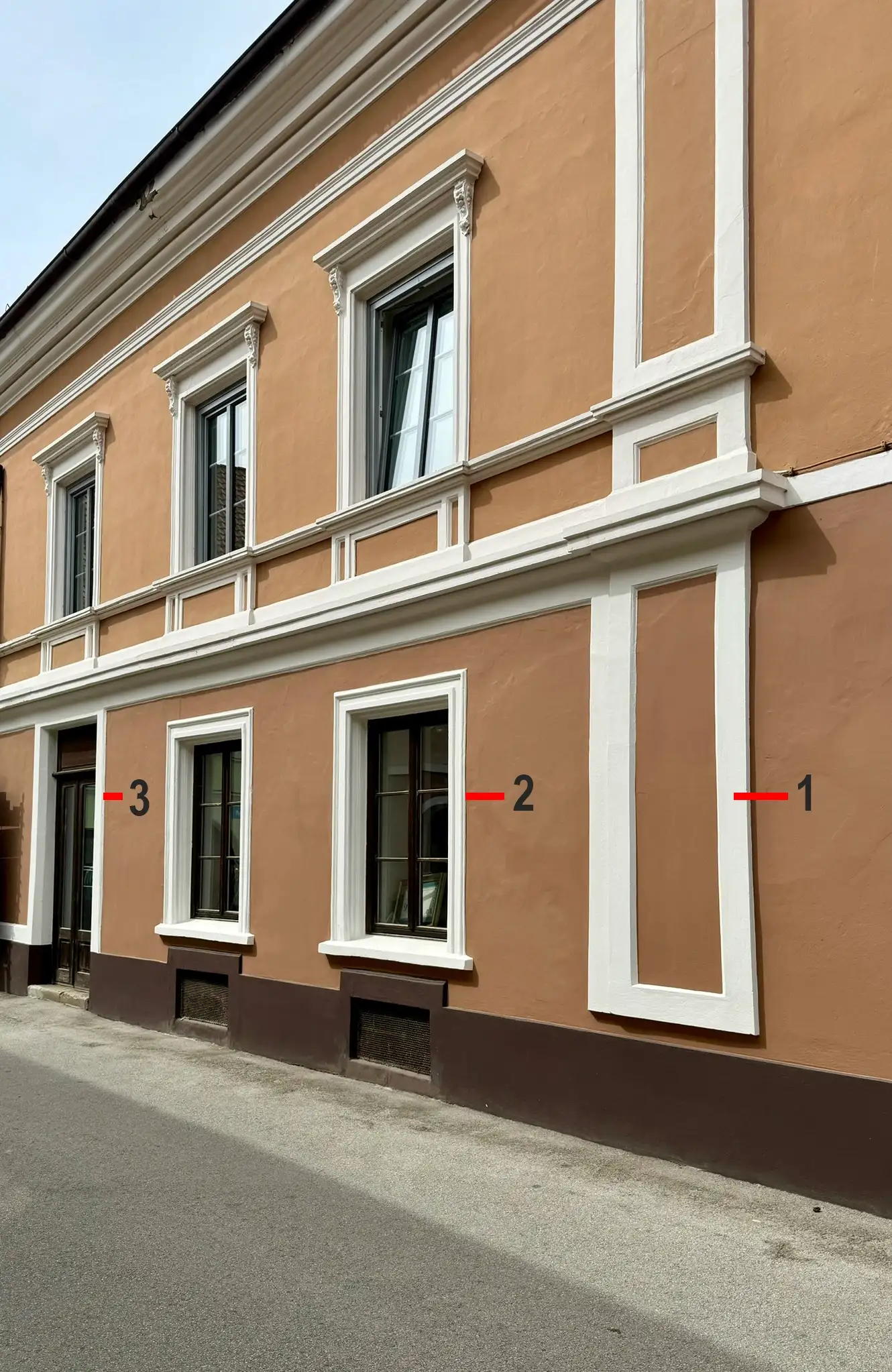
1 rectangular moulding, vertical orientation |
2 window surround, vertical member |
3 door surround, vertical member
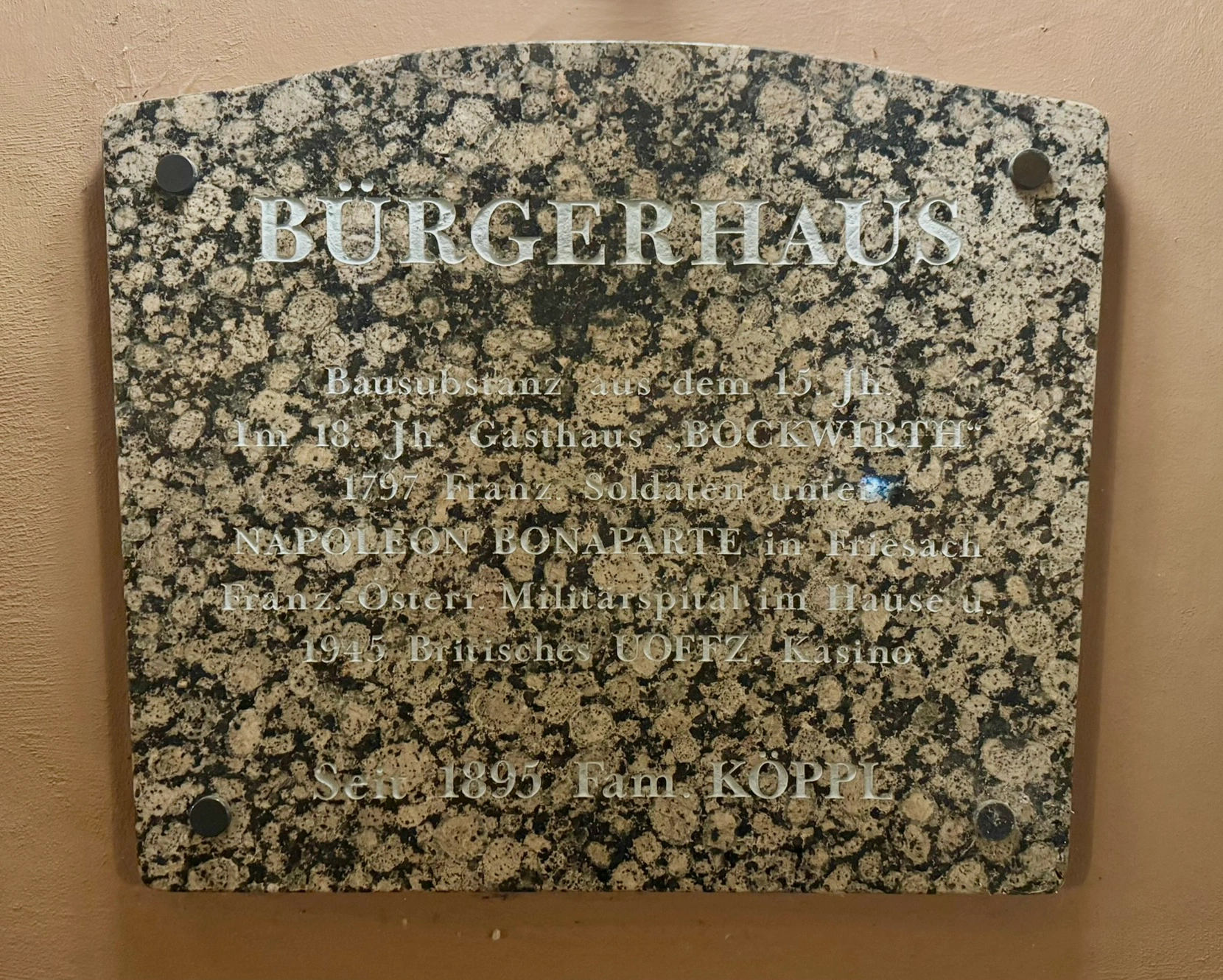
Heritage Plaque
Inscription Text in German
BÜRGERHAUS
Bausubstanz aus dem 15. Jh.
Im 18. Jh. Gasthaus „BOCKWIRTH“
1797 franz. Soldaten unter
NAPOLEON BONAPARTE in Friesach
Franz.-österr. Militärspital im Hause u.
1945 britisches UOFFZ.-Kasino
Seit 1895 Fam. KÖPPL
Explanation of the Inscription Text
The townhouse at Bahnhofstraße 3 dates back to the 15th century in its structural substance.
In the 18th century, it operated as the inn “Bockwirth”.
In 1797, during the Napoleonic Wars, French soldiers under Napoleon Bonaparte were stationed in Friesach.
At that time, the building served as a Franco-Austrian military hospital.
In 1945, it housed a British non-commissioned officers’ mess.
Since 1895, the building has been under the ownership of the Köppl family.
Traditional Inns in Carinthia
From the medieval period to the 19th century, traditional inns in Carinthia provided essential shelter, food, and stabling for travellers, merchants, and pilgrims. They also served as social hubs, hosting meetings, celebrations, and local gatherings. Many inns were family-run for generations, preserving regional architectural and culinary traditions. Their facades, signage, and interiors remain important markers of Carinthia’s cultural and historical heritage.